Investigating the Evolution of Twenty-First Century Pop Culture Using Digital Humanities Techniques

Wall of Fame neon light

| By James Carney, Senior Gale Ambassador at King’s College London |

Since the new millennium’s infancy, popular culture and famous lifestyles have captivated the public to an ever greater extent. From the emergence of social media, to the escapism provided from global crises or even the marketability of celebrities in late stage capitalism, the facets of stardom’s grip are numerous. Pop culture has always been a platform for performance – be that of one’s talent, beauty, wealth or quirkiness – but in the twenty-first century, fan reaction and engagement have assumed a far more prominent role in these public theatrics. The political, social and artistic zeitgeist has become rooted not only in celebrity action, but in the increasingly deterministic public reaction too. Gale resources can be used to present the emergence of such a dichotomy through records of both output and interpretation, illuminating the dynamics of the twenty-first century’s evolved popular culture for both academic enquiry and entertainment.
Read more

Introducing My Students to Digital Humanities Research Techniques

Woman working on laptop

│By Ben Wilkinson-Turnbull, Gale Ambassador at the University of Oxford│

Digital resources are vital to conducting academic research and teaching the next generation of scholars. As educators, teaching with technology can be daunting. In my previous blog posts PhDing in a Pandemic: The Impact of COVID-19 on Research and Teaching and Top 10 Tips for Teaching with Primary Sources, I’ve written about how you can help students get to grips with using a range of Gale Primary Sources including Eighteenth Century Collections Online, Burney Newspapers, and British Literary Manuscripts Online. But how do you help your students take the next step as digital humanists in a growing discipline? Teaching them how to use an innovative resource such as Gale Digital Scholar Lab is one way which you as an educator can help students develop their research skills and methodologies in a changing scholarly landscape.

Read more

How Gale Digital Scholar Lab Could Support Alternative Research Methods

Online working

|By Rob Youngs do Patrocinio, Gale Ambassador at University College London|

Academic research has evolved drastically in recent years, with new technology revolutionising research methods. One impact is the growing influence of quantitative analysis within the Humanities and Social Sciences. This has impacted research and student curriculums. I am currently a third-year student at University College London (UCL) studying History and Politics of the Americas with languages. Last year, my course included a ‘Research Methods’ module. The quantitative section of this module introduced me to the value of digital humanities (DH), particularly R-Studio which we took time to practise and utilise in our university projects. My institute’s different DH workshops were useful in that they enhanced the module and enriched my course as it presented a new approach to social scientific research. This challenged me to further question the complexities of QUAN vs QUAL/mixed-methods research, and to what extent they are mutually inclusive/exclusive in different research contexts.

Read more

New Experience for Gale Digital Scholar Lab

Gale Digital Scholar Lab

|By Gale Digital Scholar Lab Product Management team|

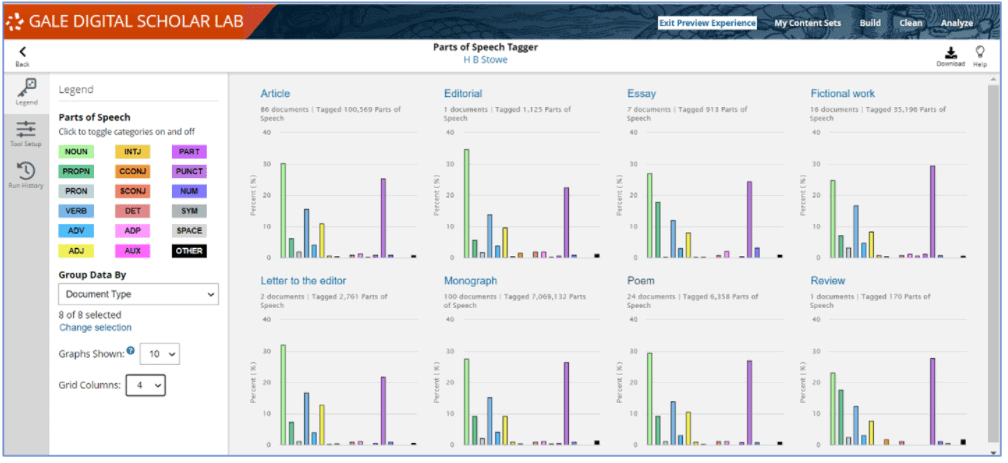
Gale Digital Scholar Lab creates new possibilities by offering solutions to the most common challenges facing researchers in the digital humanities today. Since its launch in 2018, the team has engaged with librarians, instructors, and students to find out what they’d like to see in the tool and how they use it for research, teaching, and learning. Based on those continuous conversations, the team regularly makes improvements to the user experience.

Read more

How to Survive in the Jungle of Academia? Top Tips for University Freshers

Student on university campus

│By Torsti Grönberg, Gale Ambassador at the University of Helsinki│

Starting your first week of university can undoubtedly feel daunting. When I think back to my first week at the University of Helsinki, I remember feeling overwhelmed by this strange new world I had thrown myself into. For many students, starting university means starting an entirely new chapter in their lives. Like me, you might not know anyone from your faculty, and you might be living in a completely unfamiliar city as well. University also requires an entirely different level of independence than your previous scholarly pursuits; there’s no one looking over your shoulder to make sure your work gets done on time – you and you alone are responsible for your studies. In this blog post I will detail a few tips and tricks I wish someone had told me at the beginning of my university studies and provide some general advice on how to make the most of university!

Read more

The Impact of the Pandemic on Students at the University of Johannesburg

│By Ayanda Netshisaulu, Gale Ambassador at the University of Johannesburg│

In March 2020, in what seemed to be little more than a blink of an eye, students at the University of Johannesburg were thrust into the world of online learning. First years, Honours, Master’s and even PhD students were left stranded in a rapidly changing world. With our trusted archives closed as a result of the South African lockdown, some students felt they were left with no option but to make do with secondary sources – but a historian without an archive is like an artist without paints. Luckily, Gale had opened an art supplies store in the University of Johannesburg!

Read more