
Keeping Track of Research for your Undergraduate Humanities Dissertation and Using Gale’s Digital Resources

│By Jessica Crawley, Gale Ambassador at the University of Lancaster│

So, you’re a humanities undergraduate writing a dissertation, are you? If you’re anything like me, then you’re already finding this process as overwhelming as it is exciting. You have likely never taken on a research project this vast before, and that’s okay! You’re already on the right track by clicking this blog, and by the end of your dissertation process you’ll be a pro. Most of these skills are transferrable to essays too so, even if you aren’t writing a dissertation, this blog will still be of use to you.

This is the blog that I WISH someone had written when I first started researching for my dissertation: I was clueless, directionless, and – honestly – a little bit scared to start. If you’re having any of these feelings too, then after this blog they will hopefully start to melt away. I’ll be mainly referencing Gale’s Digital Resources, but if you don’t have access to any of these then speak to your library about any similar resources they may have to offer.

Read more

Learning from the Ground Up – Hacking History in Oxford with Gale Digital Scholar Lab

Hacking History Oxford Digital Humanities Skills Workshop

│By Chris Houghton, Head of Academic Partnerships│ This blog post details the Gale Hacking History event run in collaboration with Digital Scholarship @ Oxford in May 2025. It also reflects on the value of using hackathons to teach digital humanities tools and methodologies, enabling participants with no knowledge of DH to collaboratively develop projects and … Read more

A New Course in Gale Digital Scholar Lab: Introduction to Digital Humanities

│By Sarah L. Ketchley, Senior Digital Humanities Specialist│

In today’s rapidly evolving academic landscape, digital tools are reshaping the way we study literature, history, and culture. As digital humanities (DH) becomes increasingly central to research and teaching, instructors—particularly graduate students and early-career faculty—often find themselves faced with the challenge of integrating digital methodologies into their courses. To address this need Introduction to Digital Humanities‘ offers a structured, assignable course designed to equip students with essential digital research skills. It provides an accessible, hands-on approach to digital humanities, helping instructors save valuable time while fostering critical data literacy in students.

Read more

Hacking History with Gale Digital Scholar Lab

│By Sarah L. Ketchley, Senior Digital Humanities Specialist │

On 5th December 2024, the Gale Digital Scholar Lab team, in association with Loyola University Chicago, University Libraries, offered a hands-on workshop freely available to researchers, educators, librarians, and anyone interested in exploring innovative ways to improve their digital humanities (DH) research skills. “Hacking History” brought together a diverse community for a day of collaboration, conversation and collegiality – along with some friendly competition between teams to create digital projects over the course of the day. 

Read more

Exploring Sentiment in Historical Texts With Gale Digital Scholar Lab’s New “Sentiment by Timeframe” Visualisation

│By Sarah L. Ketchley, Sr. Digital Humanities Specialist│

Gale Digital Scholar Lab has introduced a new visualisation feature in the Sentiment Analysis tool: Sentiment by Timeframe. This enables researchers to bring additional depth to sentiment analysis for historical texts. This tool is part of an ongoing effort to expand the capabilities of the Lab’s six digital humanities tools and is designed to support researchers in analysing, interpreting, and visualising data across various historical documents.

Read more

A Classroom Compendium: Digital Humanities Resources for a New School Year

│By Sarah L. Ketchley, Sr. Digital Humanities Specialist│

For the start of a new academic year, this month’s Notes from our DH Correspondent blog post is a useful resource indexing all the Notes posts to date. They are categorised below to support instructors to plan, build and deliver classroom DH curricula.  This is a great page to bookmark!

Each resource can be supplemented with detailed material in the Learning Center in Gale Digital Scholar Lab which provides step-by-step instructions in written and video formats, covering every aspect of working in the platform. 

Need additional support? Our DH team will be happy to answer your questions! Just email us at [email protected]

Read more

Bridging the Gap: Gale Primary Sources and Gale Digital Scholar Lab

│By Sarah L. Ketchley, Senior Digital Humanities Specialist│

This month’s blog post will discuss how to start the work of sourcing research documents in Gale Primary Sources (GPS) archives, before transitioning seamlessly to Gale Digital Scholar Lab to create content sets, clean OCR text data, and conduct analyses of this material to answer research questions. With this methodology, researchers are able to use the rich contextual detail and varied navigation options to begin compiling their corpus of text data outside of the Lab, which can be an attractive option if the user has an existing working knowledge of specific GPS archives, such as The Times Digital Archive, Women’s Studies Archive, or Nineteenth Century Collections Online.

There is a standardised user experience across GPS and the Lab, making the transition from one to the other familiar and streamlined. However, there are options to view documents in GPS that aren’t yet available in the Lab, which may make combining both access points useful so that no document slips through the cracks!

Read more

Finding Meaning in K-Means: Clustering Analysis in Gale Digital Scholar Lab

│By Sarah L. Ketchley, Senior Digital Humanities Specialist│

Of the six tools in Gale Digital Scholar Lab, clustering is often considered the most challenging methodology to interpret effectively. This blog post will explore the nature of this analysis tool and offer some tips for running an analysis.

Read more

Building Projects in Gale Digital Scholar Lab

│By Sarah L. Ketchley, Senior Digital Humanities Specialist│

The outcomes of digital scholarship are often ‘non-traditional’, and may include digital exhibits, websites, databases, or interactive visualisations and narratives. The underlying organisational structure of such public scholarship is that of a project, usually with a distinct triggering research question and a definitive end point. Scholars may work with collaborators or contributors from multiple disciplines.

Read more

ECCO’ing through the Ages: Exploring Reception with Gale’s Eighteenth Century Collections Online

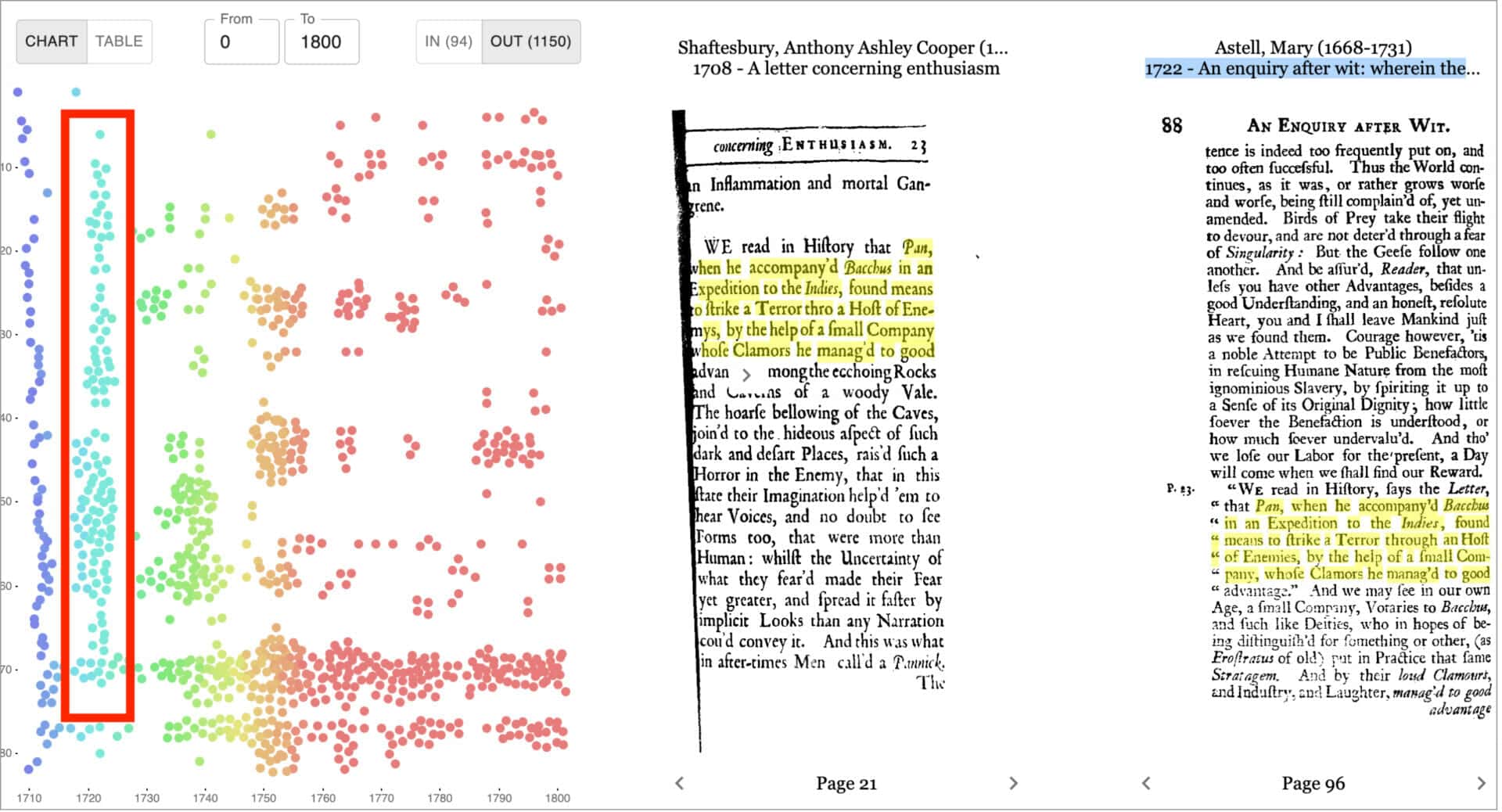
Reception Reader showing reuses of Shaftesbury’s A Letter Concerning Enthusiasm; overlaps with Astell’s An Enquiry After Wit highlighted by a red box.

│By David Rosson, Doctoral Researcher at the University of Helsinki│

A big-picture goal for the Computational History research group at the University of Helsinki is to develop methods for studying how ideas spread during the Age of Enlightenment. This was a time period marked by notable thinkers and burgeoning ideas about reason, science, human nature, the state, and society as a system operating on certain principles. These ideas have profoundly shaped the modern world we live in today and in many ways still bear influence on current affairs.

An indispensable resource for studying historical discourse in this period is Gale’s Eighteenth Century Collections Online (ECCO), which covers a considerable portion of books published in Britain between 1700 and 1800. Our research group has been working with the datasets and building research infrastructure on top of Gale’s primary sources for more than a decade. One of the latest examples of our researcher-oriented tools is a web interface, Reception Reader, that helps with the tasks of exploring text reuse patterns in ECCO documents.1

Read more