The Making of Marriage Law: Insights from Colonial Kenya

| By Lindsay Whitaker-Guest, Associate Editor, Gale Primary Sources |

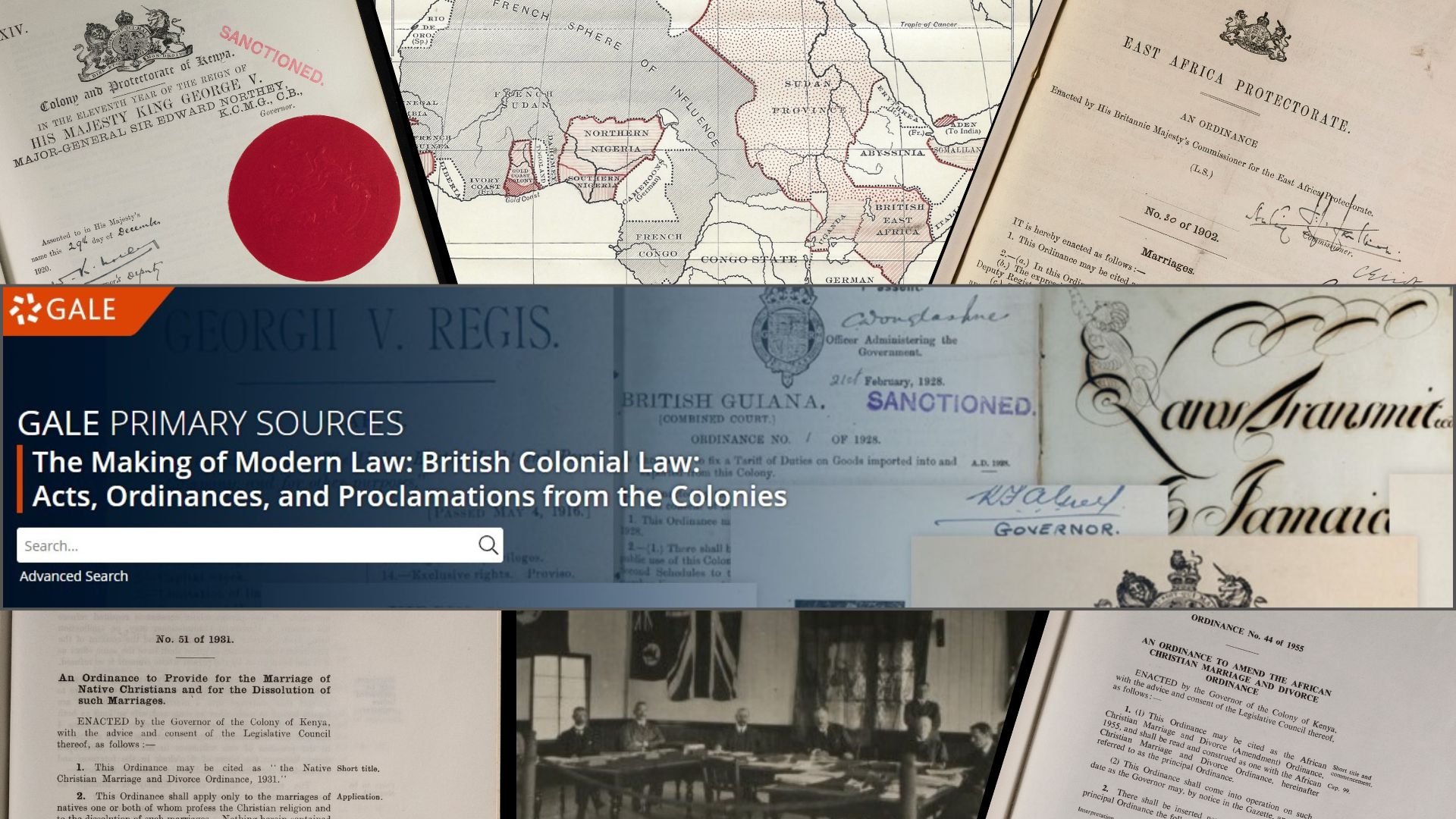
Gale Primary Sources recently released its latest module in the landmark legal history series, The Making of Modern Law. The Making of Modern Law: British Colonial Law: Acts, Ordinances, and Proclamations from the Colonies, 1900-1989 contains legislation from all corners of the British Empire and was digitised from the Colonial Office collections held at the National Archives in the UK.

The legislation in the archive covers all aspects of colonial life in a century which saw British-held territories transformed by war, disease, rebellion, and decolonisation. However, for this post we will examine how the empire governed one fundamental aspect of domestic life: marriage.

Read more

Coming Soon: Global Politics and US Foreign Policy: The Council on Foreign Relations, 1918–2000

│By Clem Delany, Acquisitions Editor, Gale Primary Sources│

December 2025 will see the launch of a new digital archive, Global Politics and US Foreign Policy: The Council on Foreign Relations, 1918–2000.

This is the digitisation of material from the Studies Department, Records of Groups, and the Records of Meetings of the Council on Foreign Relations, a non-partisan, independent US think tank focused on the international relations of the United States and its role in the world.

This role, and public perceptions of it, has altered greatly throughout the twentieth century, from the isolationist principles of the 1920s and 30s, to the American engagement in WWII and subsequent support in Allied recovery processes, to the Cold War, global anti-communist fears, and the growth of American soft power. In 2025, many of the programs of the United States Agency for International Development (established in 1961 and a key tool of US soft power) were shut down and a new phase of US international relations began.

Read more

Glam Rock to Georgian Riots: Bowie’s Last Notebook

│By Eleanor Leese, Acquisitions Editor, Gale Primary Sources

If, like me, you frequently find yourself wondering what David Bowie would be up to if his time with us mortals hadn’t been so tragically short – last week we got some answers. The BBC reported that David Bowie spent his last months deep in research about eighteenth-century Britain.

The appeal of the eighteenth century is something we know a little about here at Gale Primary Sources, as publishers of Eighteenth Century Collections Online, the largest collection of digital primary sources emerging from that century which is shortly to receive a large additional module in the form of ECCO, Part III. So, of course, the first thing that I did after learning about Bowie’s interest in our favourite historical era was to set about looking for the sources he had been reading. I wanted to see if I could find what had captured his imagination and ECCO did not disappoint.

Read more

Spanish Flu in the Time of COVID-19

│By Eleanor Leese, Acquisitions Editor, Gale Primary Sources

The first half of the 2020s brought with it political and social upheaval on a scale not seen for generations. Nothing touched the lives of more people than the COVID-19 infections that were reported in the opening days of the decade, and led to the deaths of more than seven million people worldwide. To understand these once-in-a-lifetime events, journalists turned to the most recent example of a global pandemic – still just within living memory: the ‘Spanish Flu’.

With the addition of issues for 2020 to 2024 in The Times Digital Archive, it’s possible to research the development of these two in parallel for the first time.

Read more

Digitisation as a Catalyst for Conservation

|By Margaux Lapierre, Digitisation Project Manager, British Library│

The digitisation of rare and historic materials not only makes these materials more accessible, it also supports preservation and cultural stewardship. For institutions like the British Library, where collections of printed heritage may be large and fragile, digitisation helps to safeguard materials while expanding their visibility and value in research, education, and public engagement.

Projects such as Eighteenth Century Collections Online, Part III (ECCO III), which will be released in March 2026, are a model for how digitisation and conservation complement and strengthen one another. They provide an illustration of how a library can protect the material integrity of its holdings and fulfil its mission to provide access to knowledge for as wide an audience as is possible.

Read more

A Moment of Anguish: Revisiting the Separation of Singapore from the Federation of Malaysia Through British Library Newspapers

|By Liping Yang, Senior Manager, Academic Publishing, Gale Asia|

On the morning of August 9, 1965, a visibly shaken Lee Kuan Yew, prime minister of Singapore, stood before journalists and television cameras. His voice trembled and his eyes welled with tears when he talked about the moment when the agreement “which severed Singapore from Malaysia” was signed. For him, it was “a moment of anguish.” His words marked the beginning of a new chapter for Singapore—a moment that would redefine two nations.

Sixty years on, the emotional weight of that day still echoes through the region’s political and cultural memory. But what did ordinary people know at the time? How did newspapers report the unfolding crisis, and what voices emerged in the public sphere?

Read more

In Need of Some Good News: Daily Mail Historical Archive, 2017-2021

│By Emma Harris, Associate Editor, Gale Primary Sources

The period of 2017 to 2021 spanned both my university education and then being thrust into the adult world of work – a turbulent time for any, exacerbated by a period of news headlines dominated with political fallout, freak weather, and global pandemics. This period saw elections, both in the United Kingdom and the United States, and the likes of Brexit lead to political divides within countries, and not to mention the coronavirus pandemic that absorbed most of our lives considerably from 2020 into 2021.

However, this isn’t to say these years weren’t filled with positive change at all. In fact, there was rather a lot of good news. And when we’re still dealing with the inundation of negative news topics daily – inflation and wars being some of the topics to greet me on the news this morning – sometimes it’s helpful to be reminded of the good news that’s out there too.

So, using the most recent update to Gale’s Daily Mail Historical Archive, 1896-2021, allow me to put some joy back into your day with some of the positive news that came from the last decade.

Read more

Tracing the History of Malaysia, Singapore, and Hong Kong through British Official and Non-Official Documents

By Liping Yang, Senior Manager, Academic Publishing, and Emma Harris, Associate Editor, Gale Primary Sources

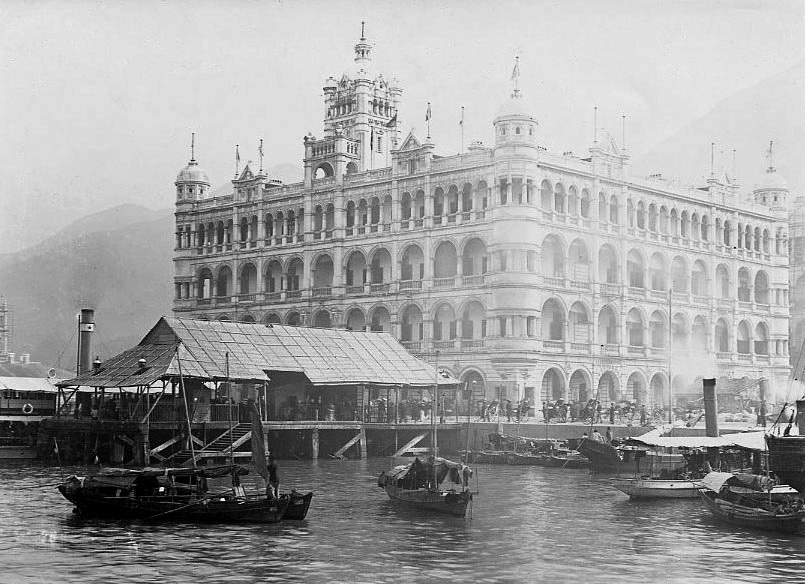
Gale has recently released Part IV in its State Papers Online Colonial: Asia series (SPOCA 4). This new module provides a perfect continuation of State Papers Online Colonial Asia Part I-III through a combination of major Colonial Office files featuring (East & West) Malaysia and Singapore as well as a curated collection of Hong Kong-related British official and non-official files selected from the archives of the Colonial Office, the Prime Minister’s Office, Cabinet Office, Ministry of Defence, and the British Council.

Consisting of around 380,000 pages of documents digitized from 15 series, this new module features a wide range of content types including correspondence, register of out-letters, registered files, government gazettes, sessional papers, and maps and plans, providing a wealth of valuable material for researching the history of Malaysia, Singapore, and Hong Kong as former British colonies between 1844 and 1997.

Read more

Exploring Latino History through the Chicano Movement

│By Phil Virta, Senior Acquisitions Editor, Gale Primary Sources

Gale’s archive Latino Social and Political Culture and History: Perspectives on the Chicano Movement presents a history of Chicanas/os in the United States with documents on programmes that brought Mexican guest workers to the country such as the Bracero Programme, organisations that evolved to support the community such as the United Farm Workers, and the individuals who helped found and advance the Chicano Movement (El Movimiento) such as César Chávez, Dolores Huerta, and Rodolfo “Corky” Gonzales. 

Labour records, correspondence, organisational papers, personal papers, manuscripts, and ephemera all contribute to our understanding of a tumultuous period in the annals of the United States. This post will introduce the background and content of this important new archive.

Read more

Global Development and Humanitarian Aid: The International Federation of Red Cross and Red Crescent Societies, 1919-1997

│By Clem Delany, Acquisitions Editor, Gale Primary Sources│

Note: Links to documents in this blog post will be provided on publication of the digital archive.

Like many people in the UK, my first experience of humanitarian appeals was through charity campaigns at school or through Blue Peter. The first one I strongly recall is sending care packages to Romania. Famine in Ethiopia and the need for wells in Africa also loom large in my memories of this era; if Matt Baker told me to give money I said how much (up to a limit of £2)?

Years later, studying history at University, I took a module on the Greek famine of 1941-1942. It was something I had known nothing about, illustrated with stark numbers of Axis requisitions, of the dead and the starving, and by accounts from survivors.

Primary sources for situations such as famines can be a real challenge for scholars; data is shaky, accounts are limited. Few people in a famine zone are there to count heads or write a dissertation; they are either struggling to survive the disaster or there to provide aid.

Read more