
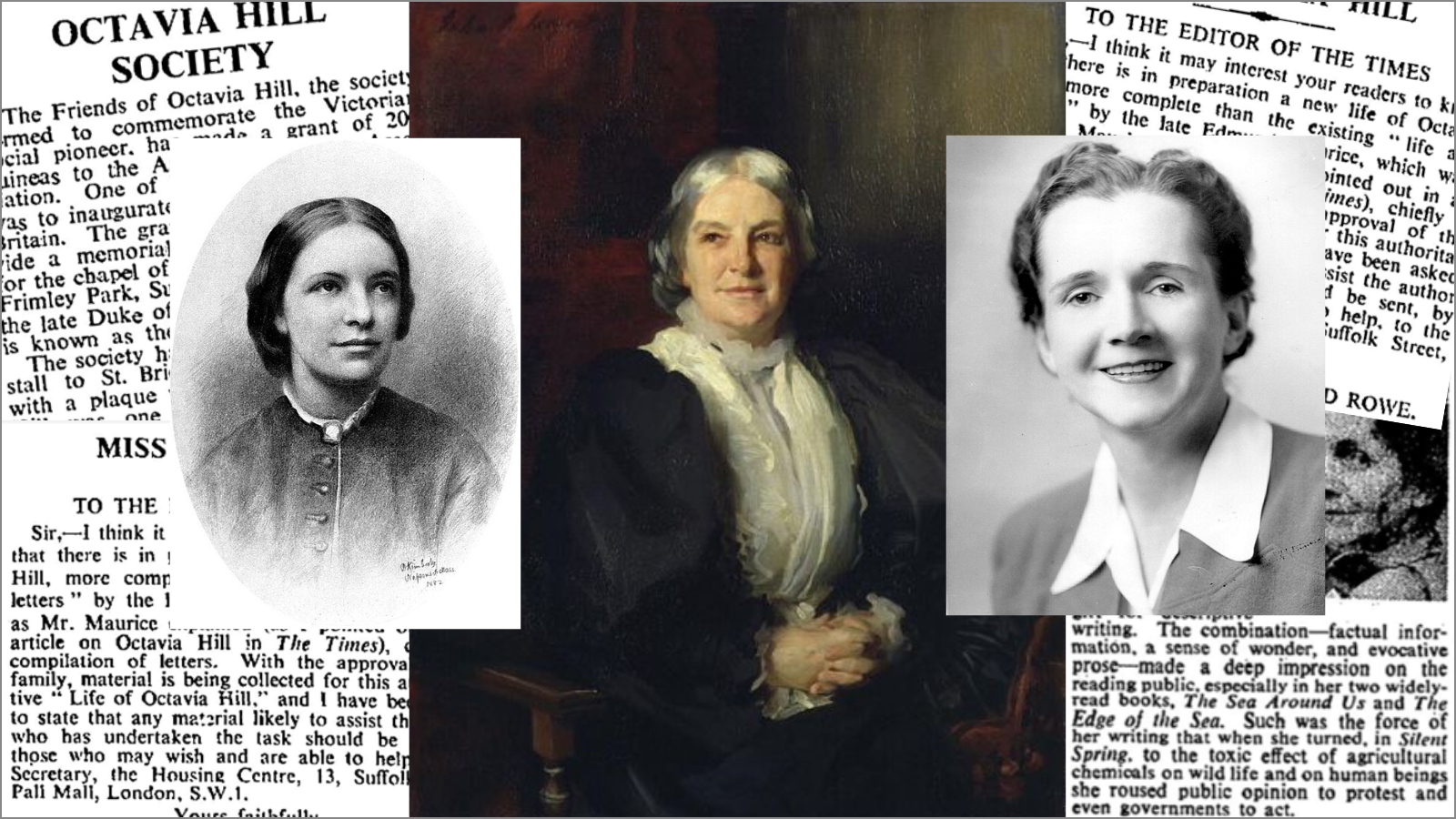
│By Brendon Ndoro, Gale Ambassador at the University of Cape Town│
Sustainability isn’t a modern term created by tech-bros. It is an invention hand-crafted by women from different communities across centuries. And the proof can be found in Gale’s The Times Digital Archive.
Octavia Hill
Miss Octavia Hill (1838-1912) was a pioneering English reformer and philanthropist during the Victorian era. She grew up having no formal schooling, and in a family experiencing severe financial ruin and bankruptcy. However, Miss Hill became one of the most influential women of her time.
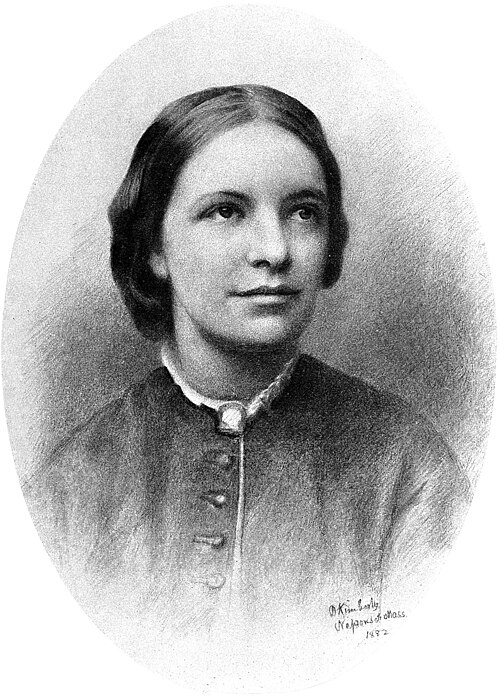
In 1864, with financial backing from John Ruskin, she bought up dilapidated, squalid properties in London’s slums. She renovated them, made them habitable, and managed them directly. She took a personal interest in her tenants. Her main priority was not ensuring rents were paid punctually, but her tenants finding employment, resolving disputes, and setting up extramural activities for children. Her work essentially birthed modern social work and housing management.
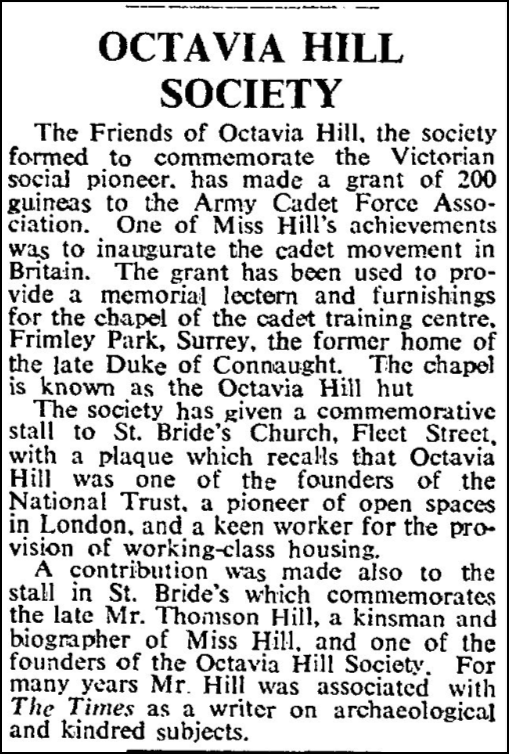
Octavia was a visionary. She understood the connection between a person’s living environment and their overall well-being. She firmly believed that access to nature, clean air, and beauty was a fundamental human right, not a luxury just for the rich. This led her to fight for the reservation of open, green spaces in London for the working class. Octavia campaigned against developers to save green spaces like Hampstead Heath and Parliament Hill from being paved over. In fact, she was the first person to coin the term “Green Belt” to describe protected rural areas surrounding a city.
Miss Octavia Hill is also most famous for being one of the three founders of the National Trust in 1895, alongside Robert Hunter and Hardwicke Rawnsley. The organisation acted as a guardian for the nation, buying and protecting places of historic interest and natural beauty so that they could be enjoyed by the public forever.
Octavia Hill’s legacy still has a massive impact on people today. The National Trust, which started as a small conservation effort, is now one of the largest conservation charities in the world, protecting over 250,000 hectares of farmland, 780 miles of coastline, and 500 historic properties across the UK.
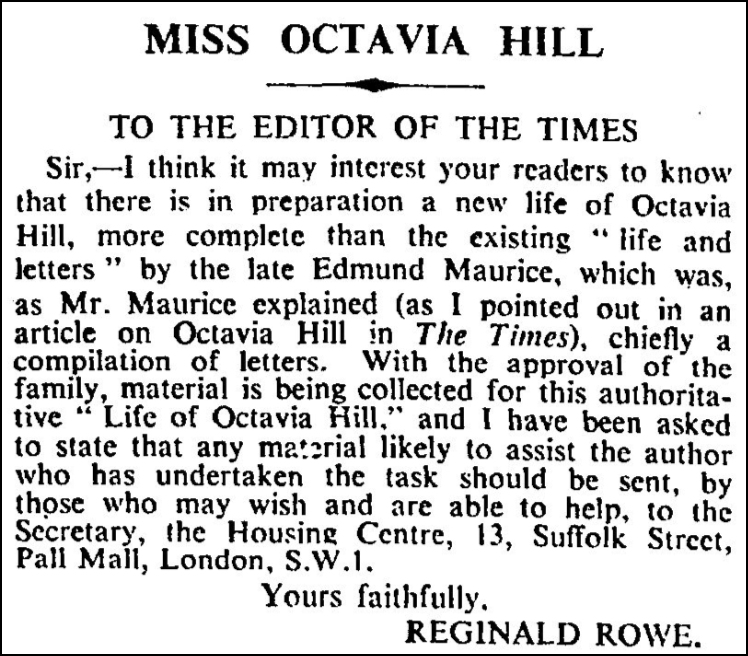
The housing association she founded still exists today as a non-profit organisation, managing thousands of homes in inner-city London and continuing her mission to provide affordable housing. When city planners advocate for parks, playgrounds, and green belts within urban environments to support public health, they are following the blueprint Octavia Hill fought for over a century ago.
Rachel Carson
Rachel Carson (1907-1964) was an American marine biologist, a conservationist and an incredibly gifted writer. She worked for the U.S. Fish and Wildlife Service, formerly known as the U.S. Bureau of Fisheries. Before becoming the face of environmentalism, Carson wrote scripts and informational brochures. Eventually, she became the Editor-in-Chief of all publications for the Fish and Wildlife Service.
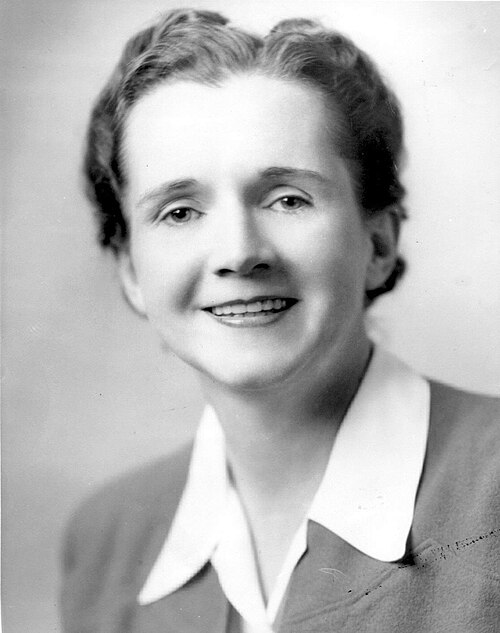
Miss Carson achieved fame from her beautifully written books about the ocean, like The Sea Around Us. She is more popularly known as the author of Silent Spring (1962). Her work has identified her as a catalyst for the global environmental movement.
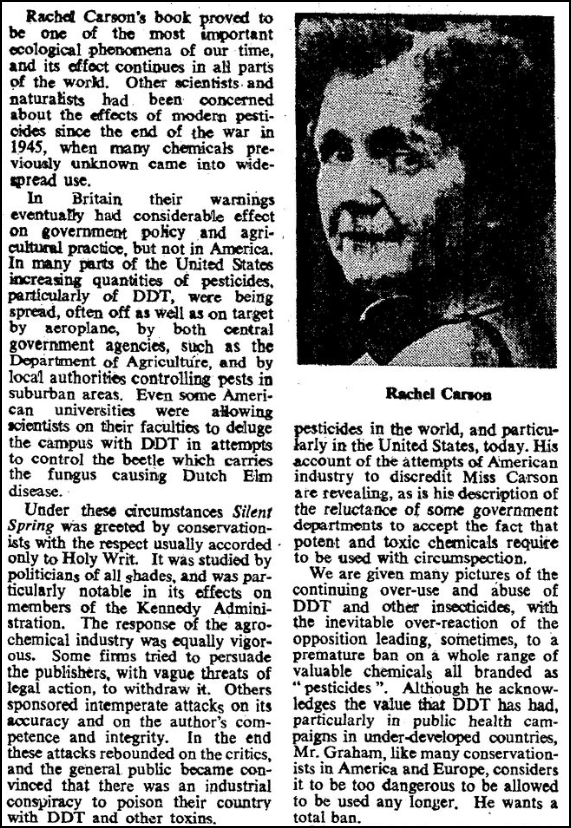
Silent Spring was a critique of the indiscriminate use of synthetically manufactured pesticides. The pesticide Dichloro-diphenyl-trichloroethane (DDT) was the main pesticide addressed in her book. Silent Spring discussed topics of bioaccumulation, the poisoning of entire ecosystems, and the illusion of control over nature through synthetic chemistry.

Carson’s book identified the potential destruction from the use of synthetic pesticides. However, this was met with multiple PR campaigns to discredit her work. Because Carson was a woman challenging science within a male-dominated establishment, the attacks she faced were deeply sexist. She was labelled as “hysterical” or “emotional.” One article in The Times Digital Archive opened with the title “False Prophets of Calamity” and was written by John Maddox, the editor of Nature.
Laying the Foundations of the Idea of Sustainability
In the Victorian era, when industrialisation was viewed as progress, it led to slums and a poor quality of living. Octavia Hill argued that there was a need for fresh air, green spaces, and natural environments for the working class. She was dismissed and labelled a naïve, sentimental idealist. Critics viewed her work as an attempt to block development or undermined her as a woman who did not understand the harsh reality of capitalist economies or urban growth.
Rachel Carson faced the same opposition nearly a century later. Because she was a woman sounding the alarm, her scientific warnings were written off. However, these women did not just argue back. They used undeniable proof and strategy to bring about a change, fundamentally laying down the foundation of idea sustainability and how it’s approached in our society today.
Whether fighting destructive urbanisation or the agenda of corporations endorsing the production of harmful chemicals, the pioneers of sustainability faced one common enemy: a system terrified of change. Women like Octavia Hill and Rachel Carson refused to be silenced. They brought the evidence and nurtured the movement for sustainable action. They did not just advocate for sustainability. They built it.
If you enjoyed reading about the intersection of historical archives and sustainability, check out these posts:
- The roots of ‘ecocriticism’: Exploring the impact of Rachel Carson’s Silent Spring
- An Exploration of Women’s Liberation: Insights from Gale Primary Sources
- Finding Black Female Authors in the Women’s Studies Archive
- Early Modern Medicine: Women’s Sexual and Reproductive Health
Blog post cover image citation: Octavia Hill by John Singer Sargent – Church Times – For houses and green space, Public Domain, https://commons.wikimedia.org/w/index.php?curid=12810979 combined with images from this blog post.