│By Masaki Morisawa, Product Solutions Consultant│
There are two American names that every Japanese schoolchild learns in history class because of the enormous impact they had on our country. One is Commodore Matthew C. Perry (1794–1858), whose visits in 1853 and 1854 helped end more than two centuries of Tokugawa diplomatic seclusion. The other is General Douglas MacArthur (1880–1964), who, as Supreme Commander for the Allied Powers (SCAP) from 1945 to 1951, oversaw the complete transformation of post-World War II Japan.
Both men embodied American power at critical turning points, but MacArthur’s influence was arguably greater. Perry jolted Japan out of seclusion and set major changes in motion, but he did not rewrite Japan’s laws, restructure its society, or govern its people. MacArthur oversaw sweeping changes in all three areas, leaving a legacy that is still debated today.
In this blog post, I’m going to explore the impact of General Douglas MacArthur using Gale’s exciting new archive collection Asia in the Twentieth Century: General MacArthur, and War, Occupation, and Reconstruction in the Pacific, 1941–1972.
From Defeat to Occupation
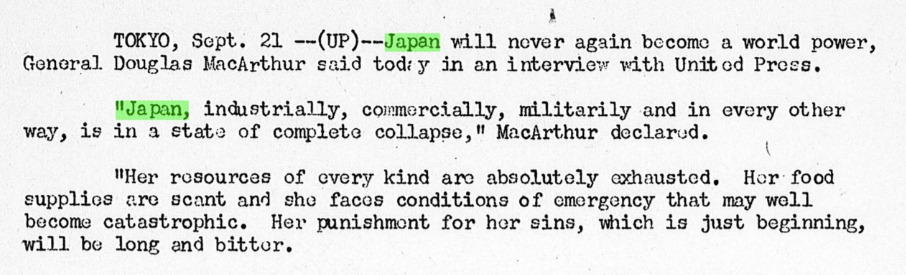
When MacArthur arrived in Japan on 30 August 1945, he faced a country devastated by war. In a United Press interview on September 21, he described the situation in bleak terms:
The occupation first aimed to demilitarise Japan and remake the country as a peaceful democracy with a market economy. MacArthur held extraordinary authority, effectively serving as the absolute ruler of Japan, and was sometimes described by historians and the Japanese public as the “Blue-Eyed Shogun”.
Although MacArthur formally represented the Allied Powers, his relationship with other Allied governments was often tense, fraught with geopolitical tension. Nowhere was this more evident than in his most lasting achievement during the occupation – the complete rewriting of the Japanese Constitution.
A Constitution – and a Race Against Time
The Far Eastern Commission (FEC) was an eleven-nation body established by the Allied Powers to set policies for the occupation and review actions taken by the Supreme Commander. However, the FEC did not officially convene for its first meeting until late February 1946, which meant that MacArthur still had time early in the occupation to bypass its authority.
One document from the MacArthur Memorial Archive and Library is especially revealing. On 17 January 1946, Colonel Charles Kades of SCAP’s Government Section was asked by Tomás Confesor of the still-inactive FEC whether his section was considering amendments to the Japanese Constitution, to which Kades answered in the negative:
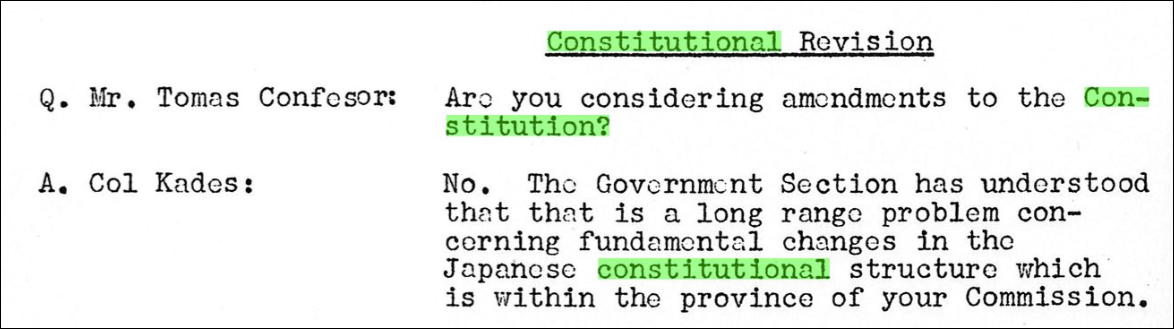
Yet on 3 February, less than three weeks after this exchange, the Government Section secretly began drafting an entirely new constitution for Japan, based on MacArthur’s now-famous three-point memo:
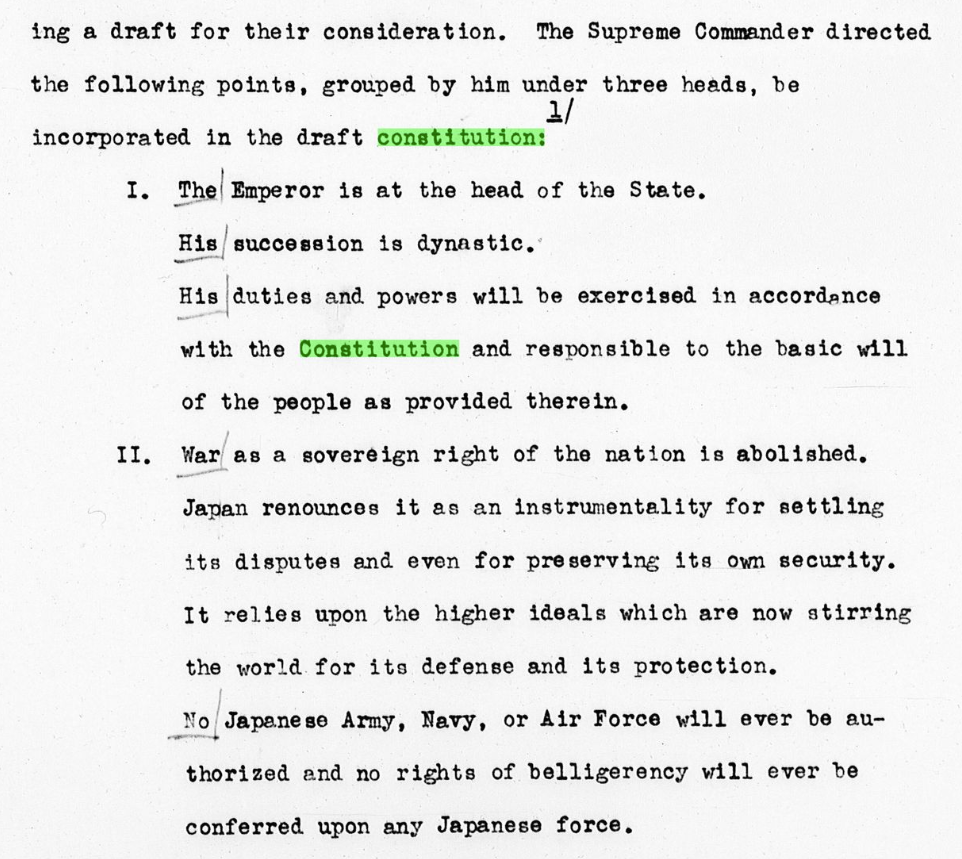
After ten days of intense work in seclusion by a youthful and idealistic Government Section team, the first draft was completed on 12 February and shown to Japanese officials the next day. By the time the FEC held its first official meeting on 26 February, the basic shape of the constitution was already set. Although the FEC managed to pass a policy in July demanding the right to review the constitution before adoption, the draft was already being debated, and it was ultimately forced to accept most of the document as a fait accompli.
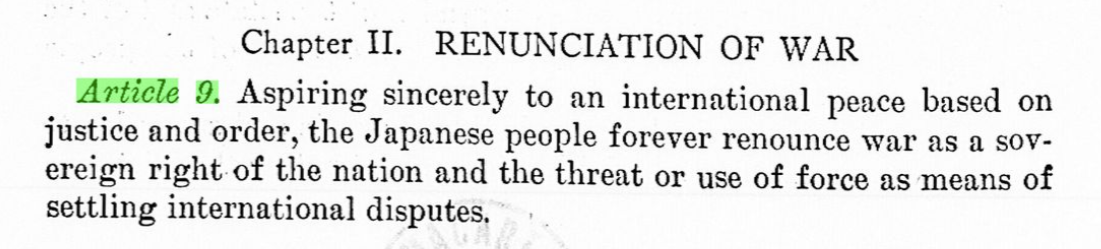
Article 9 renouncing war, which was indicated in point II of MacArthur’s memo, has become one of the best-known and most debated parts of Japan’s Constitution.

Democracy, Recovery, and the Cold War
By 1947, the Cold War was intensifying. Relations between the United States and the Soviet Union worsened, and U.S. officials grew more concerned about communist movements in Asia. A poor and unstable Japan no longer looked only like a defeated enemy; its recovery was becoming important to regional stability.
This shift in occupation policy is often called the “reverse course”. Economic recovery and political stability became higher priorities, while some earlier reforms were slowed, changed, or partly reversed.
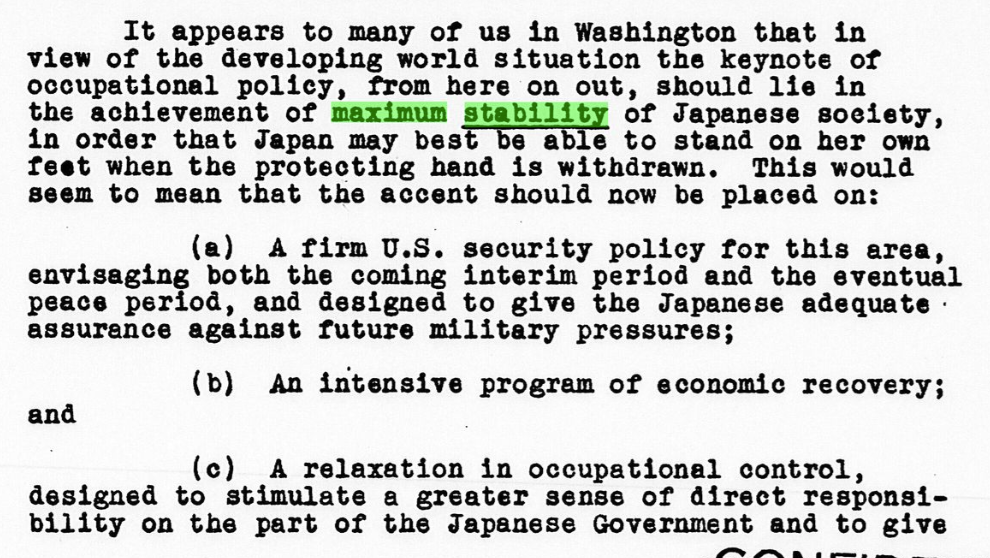
During a March 1948 visit to Japan, U.S. diplomat George F. Kennan sent MacArthur a memorandum that shows this shift clearly. Kennan said the main goal should be the “maximum stability of Japanese society”, calling for “an intensive program of economic recovery” and a gradual easing of occupation controls.
Events soon strengthened this direction. The Chinese Communist Party came to power in 1949, and the Korean War began in 1950. Japan became an important base for United Nations forces, also led by MacArthur, while – in one of the great ironies of the twentieth century – military orders connected with a war in Japan’s former colony helped set in motion the now-pacifist nation’s rise as an economic superpower.
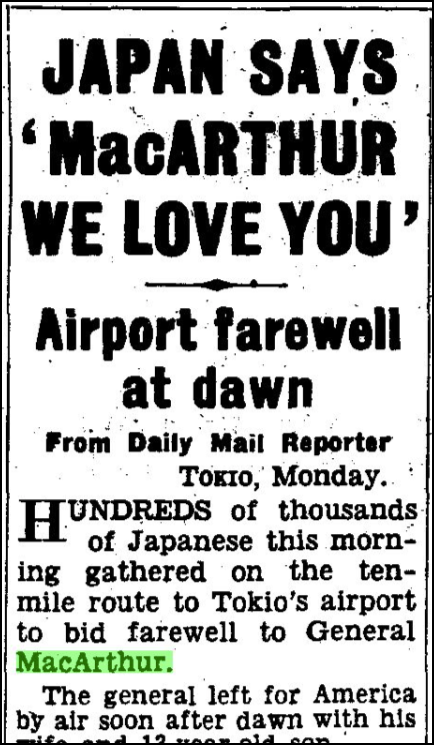
The Korean War also transformed MacArthur’s own legacy. At the height of his prestige, he was dramatically and controversially dismissed by President Truman on 11 April 1951, effectively ending his military career. On the morning of his departure, “hundreds of thousands” of Japanese citizens lined the streets from the American Embassy to Haneda Airport, some openly weeping, to see his motorcade.
A Legacy Tested by Time
Seventy-five years after his departure, the Blue-Eyed Shogun’s legacy remains deeply complex. So far, the Constitution and many occupation-era reforms have endured. However, in an era marked by deep global anxieties, some are questioning whether a pacifist constitution can survive twenty-first-century pressures1 , while others are sceptical whether democracy has truly taken root in Japan2 .
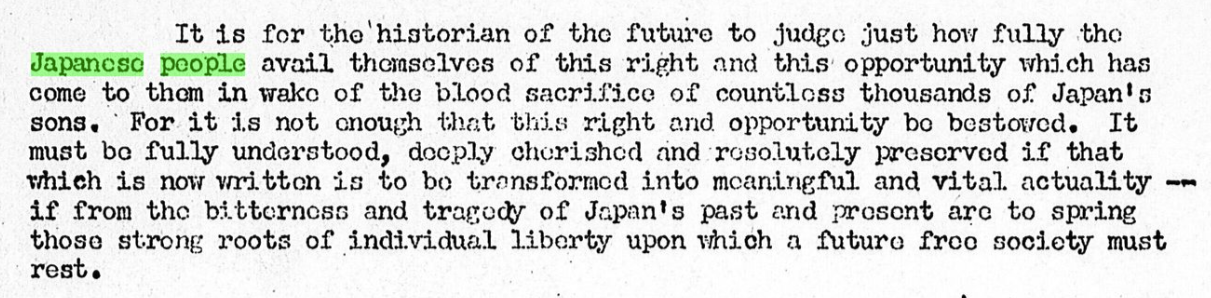
MacArthur himself believed that the true test of these reforms would come only with time. On 31 December 1946, sixteen months after his arrival in Japan, he told the Japanese people:
Click here to learn more about the new Gale Primary Sources archive collection Asia in the Twentieth Century: General MacArthur, and War, Occupation, and Reconstruction in the Pacific, 1941–1972.
If you enjoyed reading about post-World War II Japan, check out these posts:
- Douglas MacArthur – A Life in Service
- One Treaty, a Diplomat, & Three Countries
- Decolonisation in the British Empire in Asia: The Malayan Emergency and Singapore
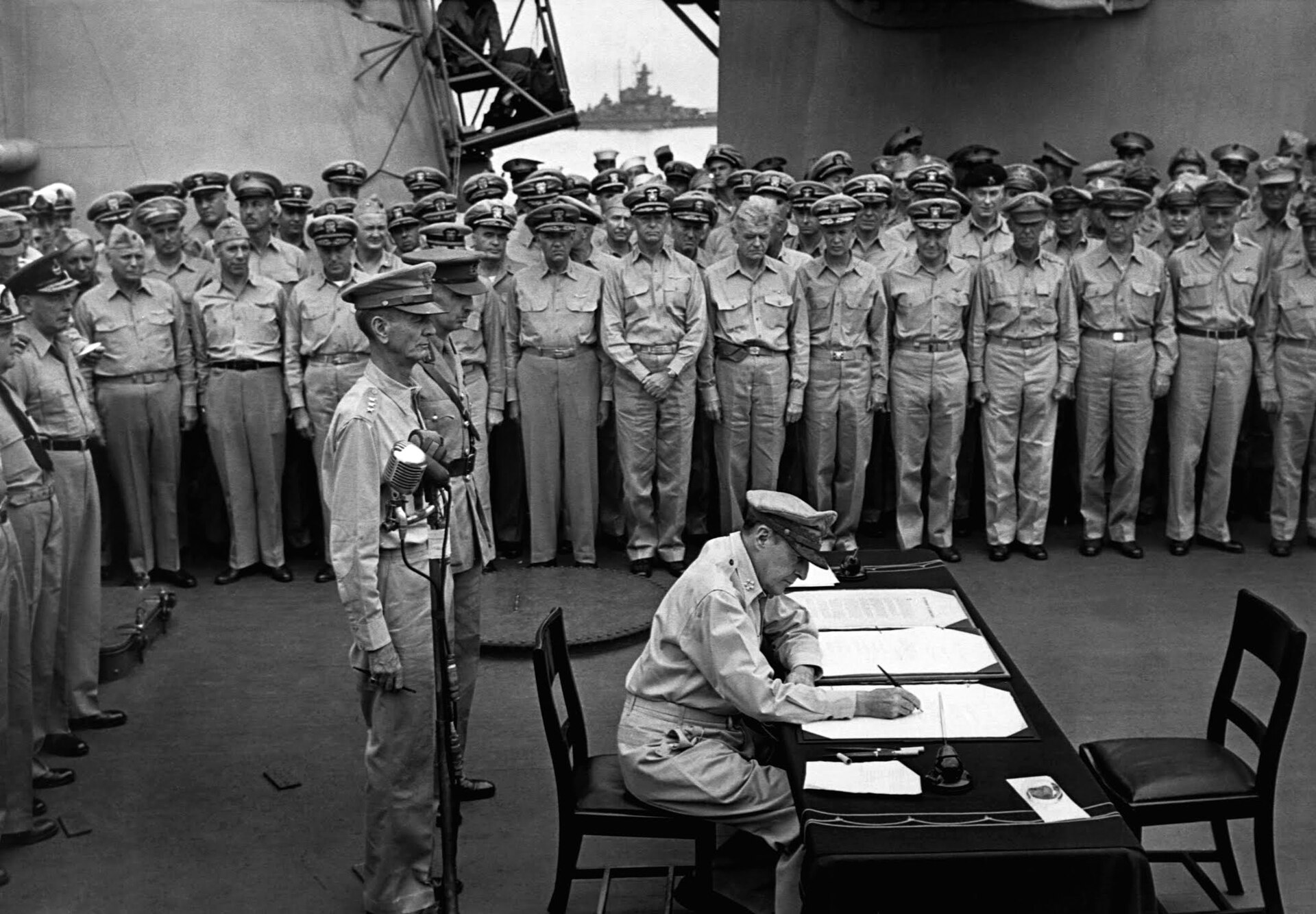
Blog post cover image citation: General Douglas MacArthur signs as Supreme Allied Commander during formal surrender ceremonies on the USS MISSOURI in Tokyo Bay. Behind General MacArthur are Lieutenant General Jonathan Wainwright and Lieutenant General A. E. Percival. 2 September 1945. United States Navy, Public domain, via Wikimedia Commons.
- Majority of Japanese Support Constitutional Revision: Poll – UPI.Com. https://www.upi.com/Top_News/World-News/2026/05/03/japan-constitution-amendment-public-support-remains-above-50/9801777847035/. Accessed 14 Sep. 2026.
- “Fewer Japanese Believe Democracy Has Taken Root | The Asahi Shimbun: Breaking News, Japan News and Analysis.” The Asahi Shimbun, https://www.asahi.com/ajw/articles/15744673. Accessed 14 Sep. 2026.