Doing Rather than Listening: Developing DH Skills at Hacking History

│By Chris Houghton, Head of Academic Partnerships│

This blog post discusses why it’s so important to provide additional value to universities at a time of unprecedented upheaval through professional development events like Hacking History workshops. It also reflects on the evolution of these events and the success of the third Hacking History event which recently took place at Coventry University.

Read more

Learning from the Ground Up – Hacking History in Oxford with Gale Digital Scholar Lab

Hacking History Oxford Digital Humanities Skills Workshop

│By Chris Houghton, Head of Academic Partnerships│ This blog post details the Gale Hacking History event run in collaboration with Digital Scholarship @ Oxford in May 2025. It also reflects on the value of using hackathons to teach digital humanities tools and methodologies, enabling participants with no knowledge of DH to collaboratively develop projects and … Read more

A New Course in Gale Digital Scholar Lab: Introduction to Digital Humanities

│By Sarah L. Ketchley, Senior Digital Humanities Specialist│

In today’s rapidly evolving academic landscape, digital tools are reshaping the way we study literature, history, and culture. As digital humanities (DH) becomes increasingly central to research and teaching, instructors—particularly graduate students and early-career faculty—often find themselves faced with the challenge of integrating digital methodologies into their courses. To address this need Introduction to Digital Humanities‘ offers a structured, assignable course designed to equip students with essential digital research skills. It provides an accessible, hands-on approach to digital humanities, helping instructors save valuable time while fostering critical data literacy in students.

Read more

Hacking History with Gale Digital Scholar Lab

│By Sarah L. Ketchley, Senior Digital Humanities Specialist │

On 5th December 2024, the Gale Digital Scholar Lab team, in association with Loyola University Chicago, University Libraries, offered a hands-on workshop freely available to researchers, educators, librarians, and anyone interested in exploring innovative ways to improve their digital humanities (DH) research skills. “Hacking History” brought together a diverse community for a day of collaboration, conversation and collegiality – along with some friendly competition between teams to create digital projects over the course of the day. 

Read more

A Classroom Compendium: Digital Humanities Resources for a New School Year

│By Sarah L. Ketchley, Sr. Digital Humanities Specialist│

For the start of a new academic year, this month’s Notes from our DH Correspondent blog post is a useful resource indexing all the Notes posts to date. They are categorised below to support instructors to plan, build and deliver classroom DH curricula.  This is a great page to bookmark!

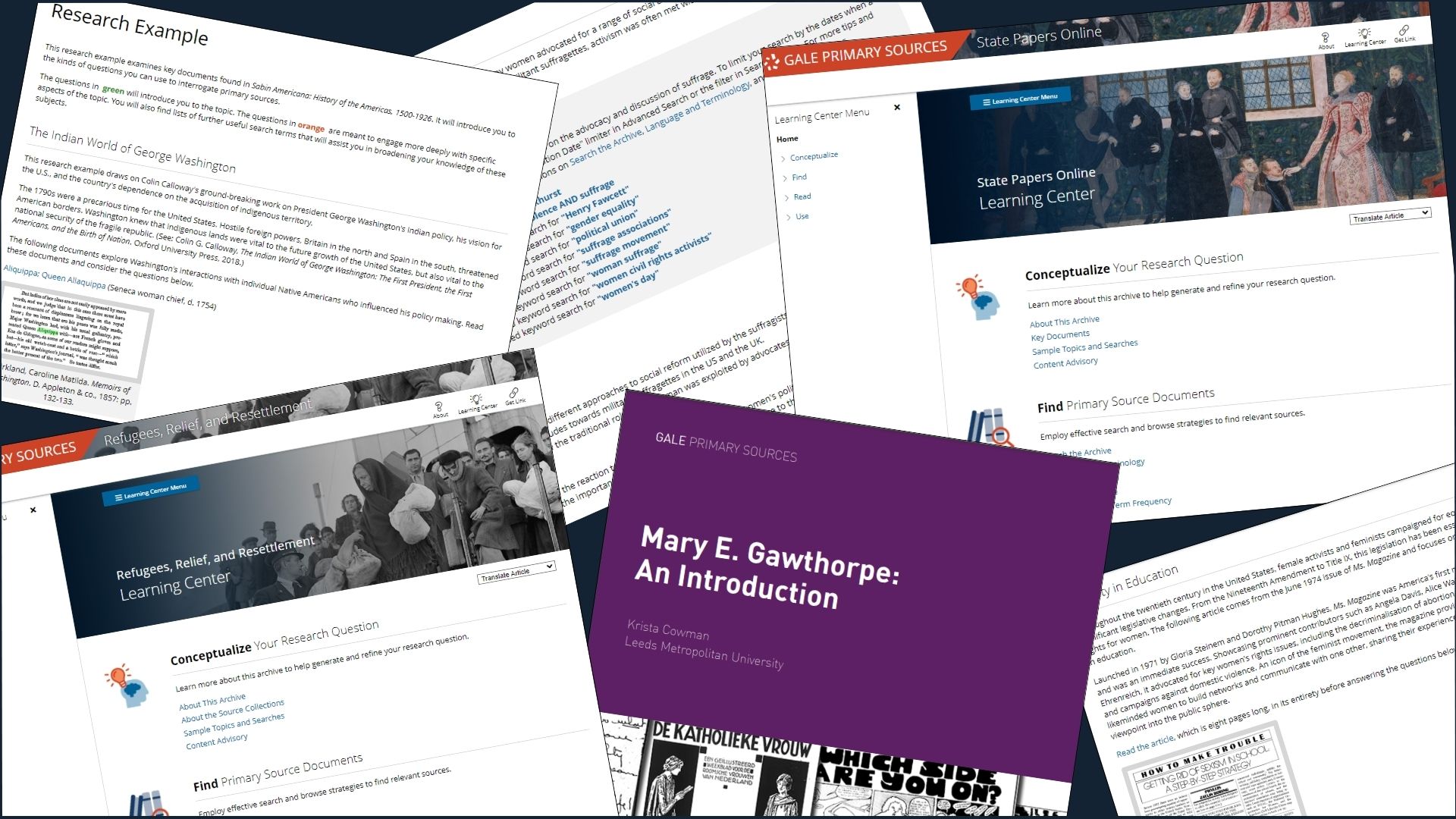
Each resource can be supplemented with detailed material in the Learning Center in Gale Digital Scholar Lab which provides step-by-step instructions in written and video formats, covering every aspect of working in the platform. 

Need additional support? Our DH team will be happy to answer your questions! Just email us at [email protected]

Read more

Gale Primary Sources Learning Centers: A Retrospective

│By Megan Sullivan, Senior Product Manager, Gale Primary Sources│

The COVID-19 pandemic and pivot to remote instruction shed light on a longstanding challenge in the humanities and related disciplines – how can instructors effectively incorporate digital primary sources into their pedagogy?

According to a 2021 study by ITHAKA S&R, two of the key obstacles to teaching with primary sources are: (1) discovery tools are not optimised to help instructors locate resources for classroom use and (2) students do not always have the required skills to find and evaluate relevant primary sources. These two problems were top of mind when designing the Gale Primary Sources Learning Centers which are now approaching the three-year anniversary of their initial release.

Read more

Coding for Humanists: Python Notebooks in Gale Digital Scholar Lab

│By Sarah L. Ketchley, Senior Digital Humanities Specialist│

Recently, three Python Notebooks were added to Gale Digital Scholar Lab to offer additional flexibility in processing and analysing text data. Each of the Notebooks can be downloaded by a researcher, then used or adapted to suit individual needs. This blog post offers some considerations for those interested in incorporating Python-based workflows into their text analysis pipeline but aren’t quite sure where to start.

This blog can also be read in conjunction with Women’s History Month in Gale Digital Scholar Lab: Named Entity Recognition, Python Notebooks, and an Intrepid Female Diarist which offers some practical programming insights into a project using Named Entity Recognition.

Read more

Playing Games with Data: Building Interactive Narratives with Twine

│By Sarah L. Ketchley, Senior Digital Humanities Specialist│

The Digital Humanities Summer Institute, at the University of Victoria, BC, has taken place every June since 2001. The intensive week of workshops, lectures, papers and social gatherings has a long history of active engagement in learning, conversation and discussions of research and methodologies.

I have had the opportunity to attend each year since 2011 and have participated in 5-day workshops on topics ranging from text encoding, digital project management, mapping, data visualization, IIIF viewers, python programming, cloud computing and DH for department chairs and deans. As an academic with an active research agenda and regular engagement in both undergraduate and graduate classrooms, I have come to greatly value the in-depth and diverse conversations taking place during the week, and 2024 has been no exception.

Read more

Finding Meaning in K-Means: Clustering Analysis in Gale Digital Scholar Lab

│By Sarah L. Ketchley, Senior Digital Humanities Specialist│

Of the six tools in Gale Digital Scholar Lab, clustering is often considered the most challenging methodology to interpret effectively. This blog post will explore the nature of this analysis tool and offer some tips for running an analysis.

Read more

Building Projects in Gale Digital Scholar Lab

│By Sarah L. Ketchley, Senior Digital Humanities Specialist│

The outcomes of digital scholarship are often ‘non-traditional’, and may include digital exhibits, websites, databases, or interactive visualisations and narratives. The underlying organisational structure of such public scholarship is that of a project, usually with a distinct triggering research question and a definitive end point. Scholars may work with collaborators or contributors from multiple disciplines.

Read more