
| Dr Clare Horrocks, Associate Professor in Print Culture and Public Engagement, Liverpool John Moores University|
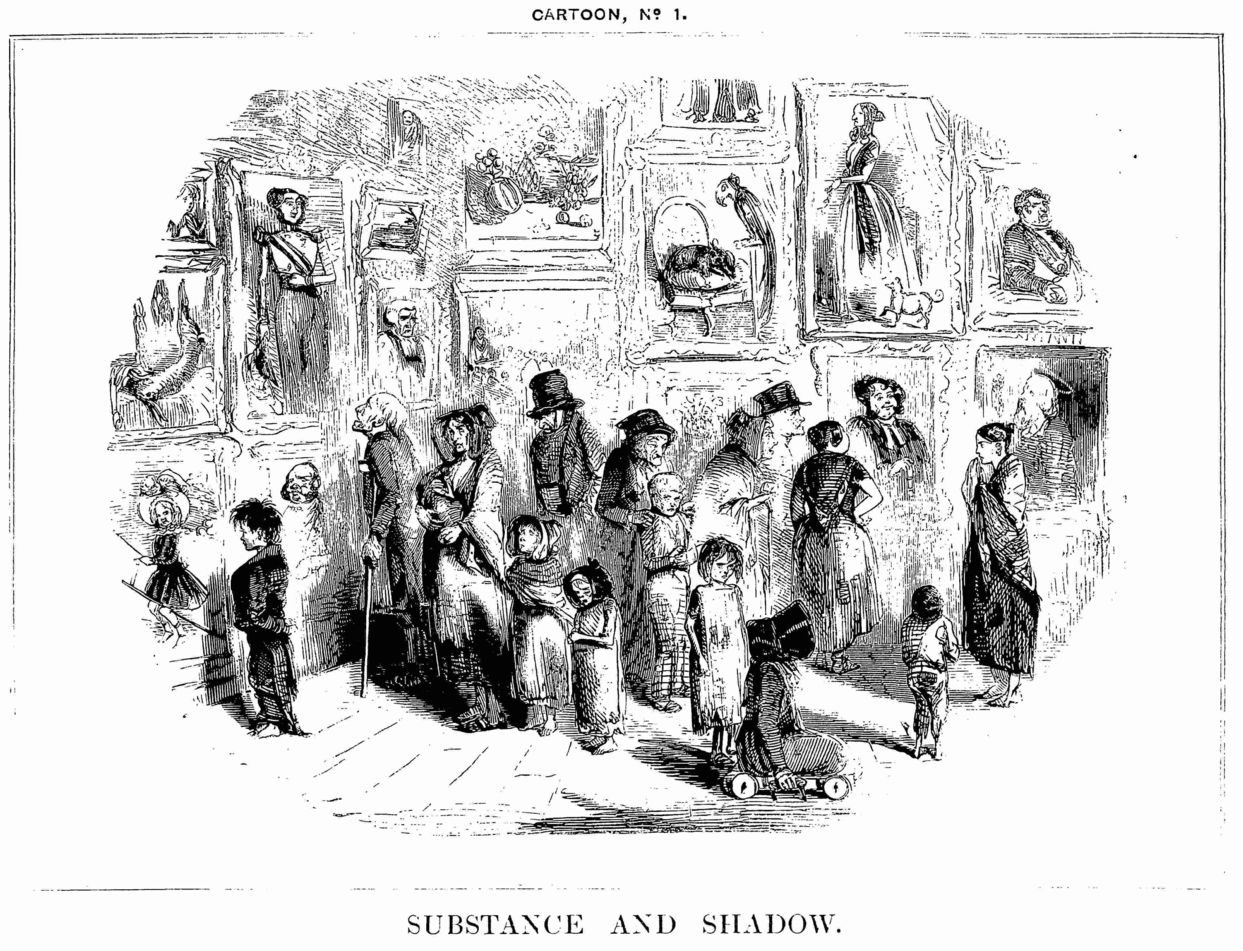
Do you have fond memories of sitting at the doctors or dentists and flicking through the latest copy of Punch? Have you ever wondered about the origin of satirical cartoons? The Punch Historical Archive can help those on a nostalgic journey, as well as students and scholars who use it as a gateway to illustrate the past. Published from July 1841, creating the first cartoon ‘Substance and Shadow’ in 1843 (see this blog post’s title image), Punch was the longest running satirical periodical, spanning two centuries. It paved the way for publications like Private Eye and its response to news and current affairs can be seen to have influenced many contemporary television shows like Have I Got News for You.
First published in 2014, the Punch Historical Archive was a pioneering contribution to the field of authorial attribution studies. Collaborating with the British Library, Punch Limited and Liverpool John Moores University, it combined digital precision and prowess with a keen understanding of the user experience. I was an Academic Advisor for the project, coordinating the transcription of the Ledgers and ensuring that, for the first time, readers of Punch would be able to identify those who wrote for the magazine. Some of these writers, like William Makepeace Thackeray and Douglas Jerrold, are already well known, but other contributors like P. G. Wodehouse and A. A. Milne less so.
This blog starts to look at some of the fantastic projects and discoveries that have arisen in the first ten years since the digital archive was produced. This year, 2026, also marks 185 years since Punch was first published, so it is also a good time to consider where the Punch archive may take us in the future.
William Makepeace Thackeray: Writer and Illustrator
Most well known as the author of Vanity Fair (1848), Thackeray was also a prolific writer for the Victorian periodical press, being on the staff of Punch magazine. The Punch Historical Archive allows users to search specifically by author; keyword “Thackeray”. An Advanced Search, selecting “author/creator”, reveals that his first piece was “The Ducal Hat for Jenkins,” published in January 1844.1
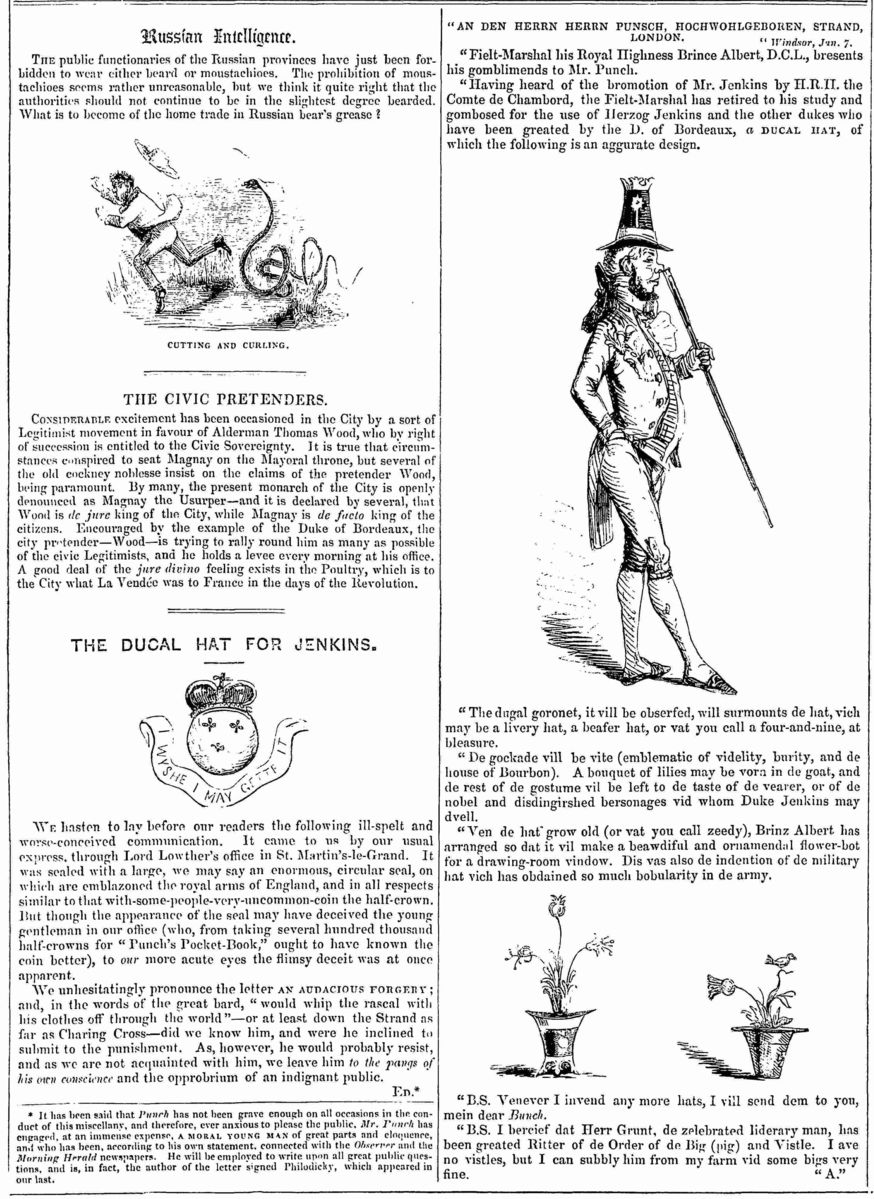
Thackeray spent his formative years in Paris, a place he said was a source of inspiration for his work. Whilst in France, he would have been aware of Charles Philipon’s Parisian satirical newspaper, Le Charivari. Therefore, it is no surprise that he brought this knowledge to his work for Punch, subtitled “The London Charivari”. Topics referring to and lampooning the French are frequently found in Punch.
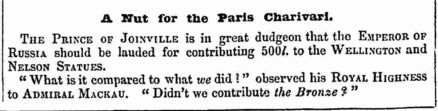
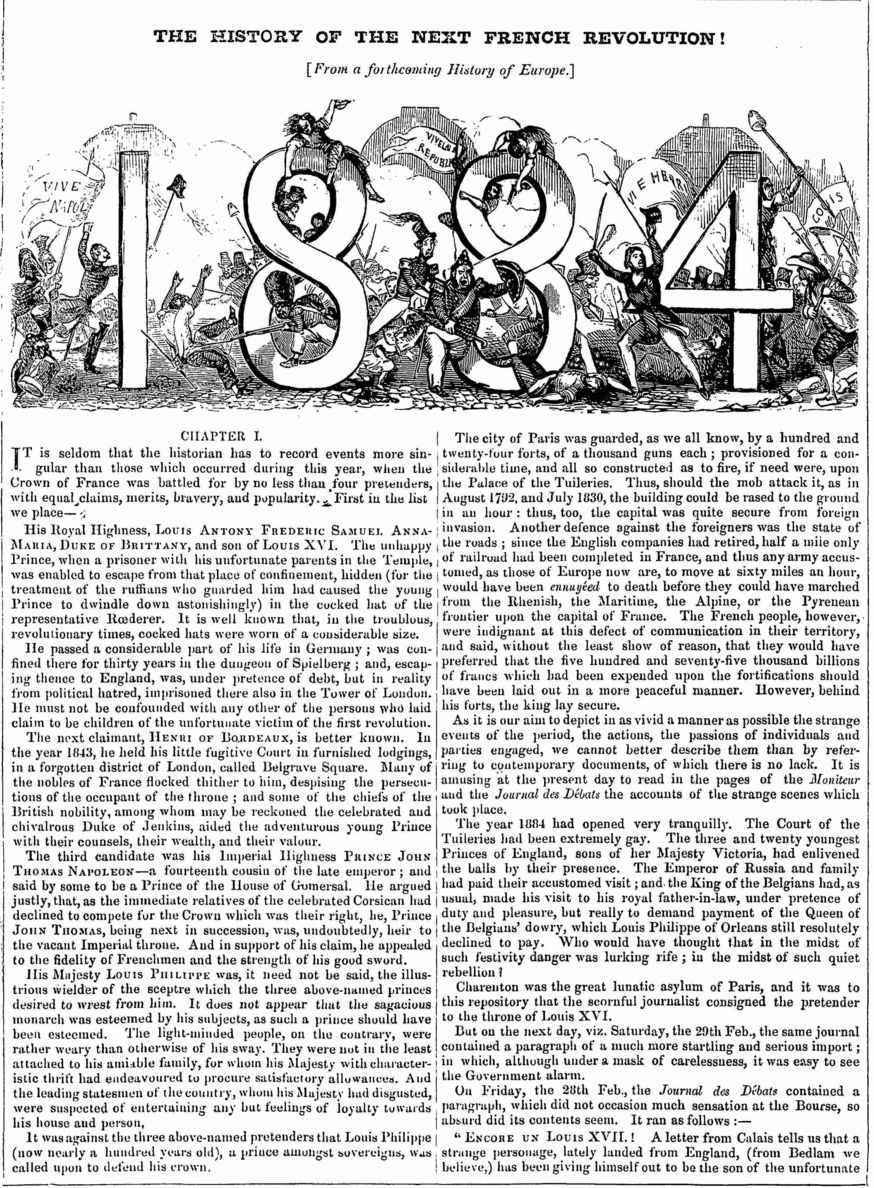
Thackeray published a variety of different styles of satire, from short jokes to longer serials like “The Snobs of England”. Their size could vary from a few lines to half a column or even two; this is how they are recorded in the Punch Contributor Ledgers.
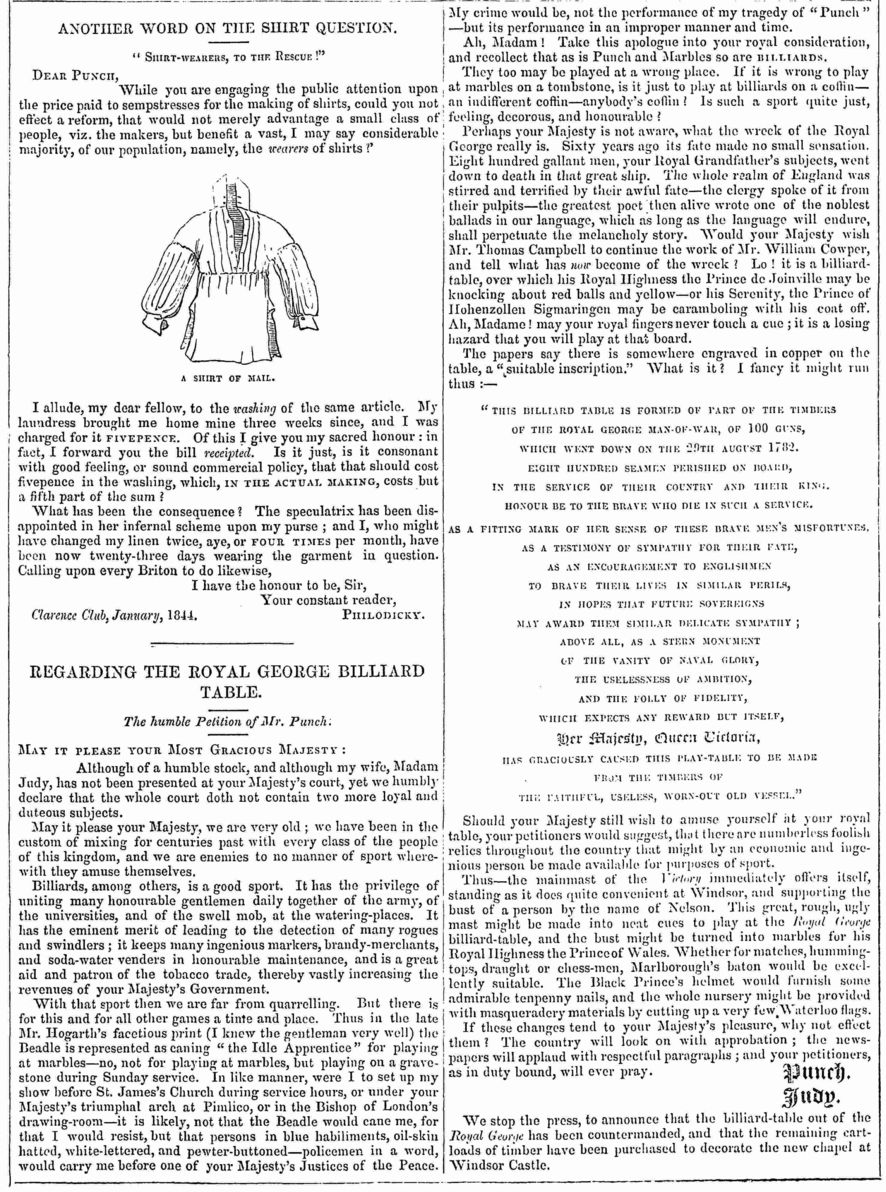
Sometimes pieces were grouped together, so it wasn’t always easy to identify which pieces belonged to which author. However, myself and Gary Simons used the Punch Contributor Ledgers to find TWO new pieces that have never been attributed to Thackeray before. Both “Another Word on the Shirt Question” and “Regarding the Royal George Billiard Table” are listed as Editor because Thackeray was not listed as a member of staff at the time they were published. But with some detective work, Simons and I were able to show that it was Thackeray – see “From Paris to Punch: William Makepeace Thackeray and a New Era in Social Satire”, Victorians: Journal of Culture and Literature (Fall 2011).
This discovery made us realise just how important it was to be able to search for contributions by author. We used this case study to campaign for Gale Cengage to commission a full transcription of the Ledgers from 1843 through to 1919, hoping that there would be more wonderful discoveries and hidden authors. Work began on the collaboration in 2012.
Punch’s Sisterhood of Contributors
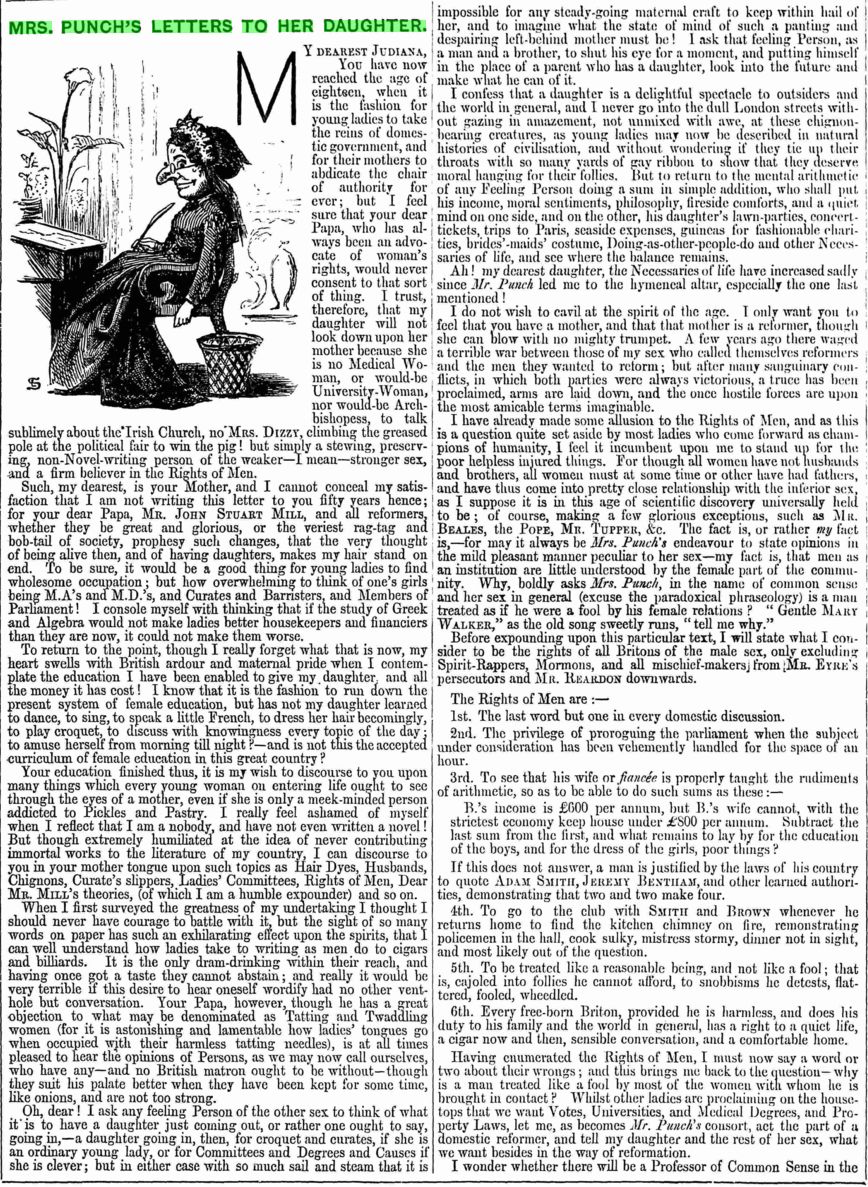
In 2015, a year after the launch of the Punch Historical Archive, I was delighted reveal a new project arising from being able to identify authors. Presenting at the International Centre for Victorian Women Writers in Canterbury, I demonstrated that Punch was not solely the ‘Brotherhood’ of writers that it was largely perceived to be. In July 1868 Matilda Betham Edwards published “Mrs Punch’s Letters to her Daughter”. This was a parody of Douglas Jerrold’s “Punch’s Letters to his Son”, created in the 1840s. At over two columns long and the start of a full series, it was not an insignificant entry for the first female contributor.
From the 1880s, with the appointment of Francis Burnand as editor, women on the staff became more commonplace. There are over one hundred entries in the Contributor Ledgers 1868 – 1899, with many more thereafter, up to the conclusion of the Ledgers in 1919. Such a rich wealth of contributions still requires further study. For International Women’s Day 2024, I created an online archive and exhibition of all these contributions which you can view here. Why not use this in conjunction with the Punch Historical Archive to start your own project?
Creating New Opportunities for Research
This blog post shows you a few ways you can begin to understand the popularity of Punch from 1841 to 1992. The addition of authorial attribution gives you the opportunity to consider why authors may write the way that they do; were there particular topics each contributor had an interest in? Does biographical information help you find the meaning of their pieces better? With over 80,000 authorial attributions identified, the Punch Historical Archive is a rich repository for further study.
Between 2022 and 2024 alone, there were over 1,493,028 searches undertaken on the archive. This blog celebrates all those searches and the projects that the archive has supported, but it also wants to create an interest in pursuing new opportunities. I have dedicated my career to the wider Punch Contributor Ledgers project and collaboration with Gale Cengage, and I hope that we can continue to excite users with new discoveries and developments. But, while I am working on these improvements, why not dive into the archive yourselves, find an author, build a profile; you never know what you may find.
You may like to read further work by Clare Horrocks here:
- C.L. Horrocks (February 26, 2025). Into the Archives: Pocket Books, Almanacks and the Punch Contributor Ledgers. In Punch’s Pocket Book: Archiving an Archive. https://doi.org/10.58079/13fvq
If you enjoyed reading about The Punch Historical Archive, check out these posts:
- Packing a Punch in Colonial Australia
- “Even the Sacramental Cup was not Exempt from Adulteration” – The Hazards of Drinking an Old Bottle of Claret
- ‘The Very Latest Craze’. Slumming Parties in the Late-Nineteenth Century
Blog post cover image citation: [John Leech]. “Cartoon, No. 1.” Punch, vol. 5, no. 105, 15 July 1843. Punch Historical Archive, 1841-1992, http://link.gale.com/apps/doc/ES700314657/PNCH?u=webdemo&sid=bookmark-PNCH&pg=3&xid=f971839b
[1] Academic articles argue there were earlier pieces by Thackeray, but the archive information is taken from the Punch Contributor Ledgers which began March 1843.