| By Phil Virta, Senior Acquisitions Editor, Gale Primary Sources |
Dolores Clara Huerta (1930-2026) was a fierce proponent of freedom, equality, and worker’s and women’s rights. She passed away on October 28, 2026, leaving behind a legacy of inspiring social activism. She spent decades working and sacrificing to make the world a better place, and we can celebrate a life dedicated to service and social justice. Within Gale’s Perspectives on the Chicano Movement archive, we can dig into digital primary source materials to learn more about her life and work, and the impact she had on so many people from all walks of life.
Founding the United Farm Workers Union
In 1962, Dolores Huerta co-founded the National Farm Workers Association with César Chávez, which went on to become the United Farm Workers, a powerful labor union protecting the rights of agricultural workers in the United States. She was a driving force within the UFW, holding many roles within the organization: vice president, chief negotiator, lobbyist, boycott strategist, and public spokeswoman.
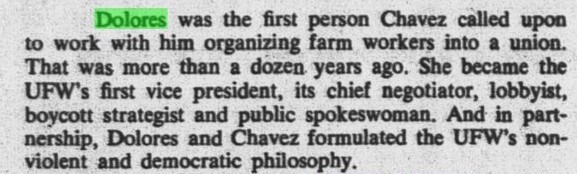
Huerta, Dolores; Speeches, Interviews, Clips. n.d. MS Office Files of the President of the United Farm Workers of America, 1951-1992: Part 3: 1962-1990 Box 46 Folder 12. Walter P. Reuther Library at Wayne State University. Latino Social and Political Culture and History, https://link.gale.com/apps/doc/OPVGGW619417731/LSPC?u=virta&sid=bookmark-LSPC&xid=997480f6&pg=5
The Delano Grape Strike
Huerta was instrumental in organizing participation of Mexican American workers in the Delano Grape Strike of 1965, in solidarity with the Filipino American workers who had begun the protest. At that time, farm workers were excluded from standard labor protections under the National Labor Relations Act. Huerta helped organize 5,000 grape workers into a cohesive, peaceful force for change.
It took five years of picketing, occasional fasts by key leaders, and nonviolent protests to finally effect change. In the end, it was Huerta who negotiated a union contract to gain wage increases, health plan contributions, pesticide protections, and grievance procedures for thousands of farm workers.
The strike was as much about civil rights as labor rights; everyone deserves equal protection of their basic human rights and freedoms. In an interview years after the strike, César Chávez summed up why Huerta was so important to the UFW: “No march is too long, no task too hard for Dolores Huerta if it means taking a step forward for the rights of farm workers.”
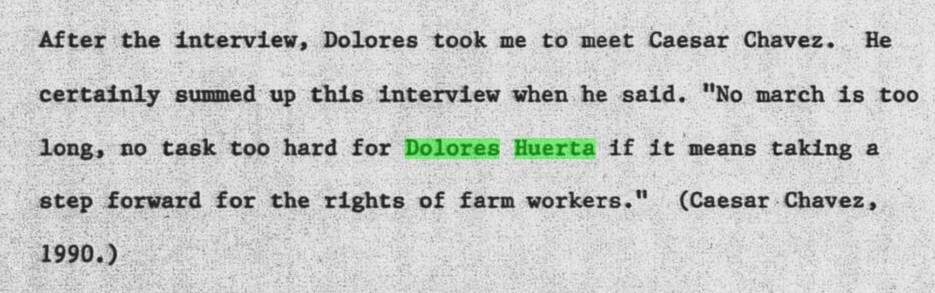
Huerta, Dolores; Speeches, Interviews, Clips. n.d. MS Office Files of the President of the United Farm Workers of America, 1951-1992: Part 3: 1962-1990 Box 46 Folder 12. Walter P. Reuther Library at Wayne State University. Latino Social and Political Culture and History, https://link.gale.com/apps/doc/OPVGGW619417731/LSPC?u=virta&sid=bookmark-LSPC&xid=997480f6&pg=59
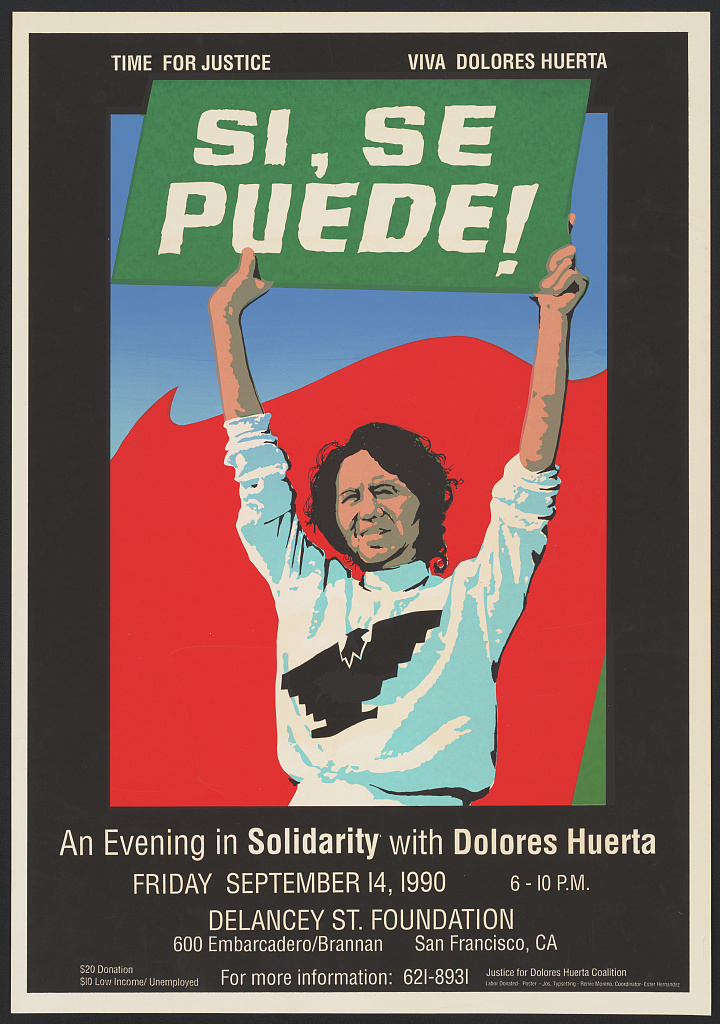
Library of Congress, Prints & Photographs Division, © Jos Sances, [reproduction number, e.g., LC-DIG-ppmsca-12345]
Accessed at https://www.loc.gov/resource/ppmsca.75976/
“Yes, it can be done!”
“Sí, se puede” – a phrase so simple yet profound – became the motto for the United Farm Workers and was credited to Huerta. “Sí, se puede” can be translated in English as “Yes, you can”, but the UFW uses the more literal English translation as their motto — “Yes, it can be done!” It is generally believed Huerta came up with the slogan during a non-violent protest in Arizona in 1972 at which time a law had been passed placing restrictions on farmworker organizing, strikes, and boycotts.
She asked for help from the Mexican American community in fighting the law, but some were of the opinion that farmworker organizing could not be done in Arizona – “No se puede”, “No, it can’t be done.” Huerta would not back down, responding “Sí, se puede en Arizona”, “Yes, it can be done in Arizona.”
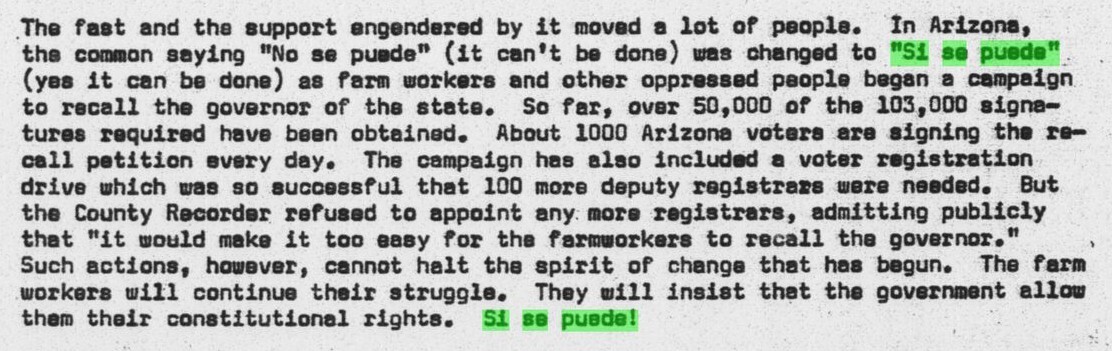
Boycott; Philadelphia, Pennsylvania. 1972-1973. MS Papers of the United Farm Workers of America Work Department, 1969-1975 Box 2 Folder 3. Walter P. Reuther Library at Wayne State University. Latino Social and Political Culture and History, https://link.gale.com/apps/doc/BAGCSV111441957/LSPC?u=virta&sid=bookmark-LSPC&xid=a0fc5a08&pg=53
“Sí, se puede!” became a rallying cry for the UFW, and later for generations of Latina/o activists and citizens who were struggling against injustice and wanted to make a better future for themselves and others. Echoes of the same call to action can be found throughout history, from “We can do it!”, rallying female workers during World War II to Barack Obama’s 2008 presidential campaign slogan “Yes we can”.
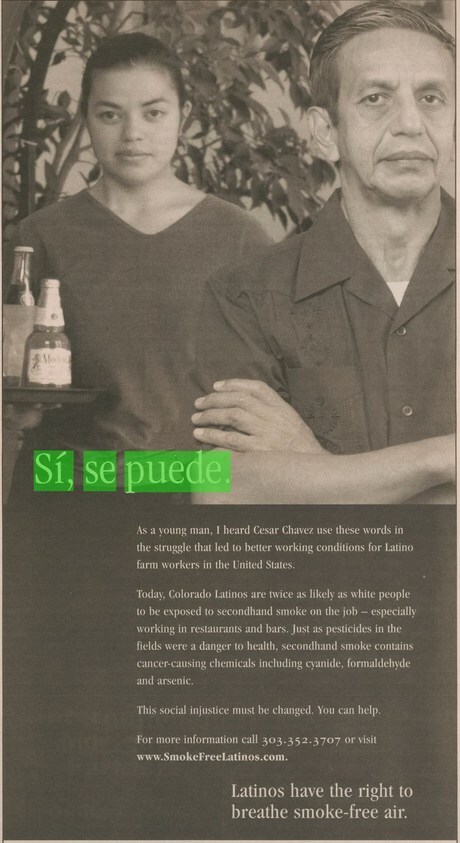
Reporting on Richard Castro’s Legacy: Newspapers including El Semanario, Urban Spectrum, La Voz, la Noticias, Denver Herald Dispatch. 1991-2006. MS Richard T. Castro and Virginia Montaño Papers, 1955-2019: Series 11: Oversize, 1961-2016, undated: Personal and Family Materials, Writings, and Scrapbooks, 1961-2016, undated WH2440 Box OVBOX 8. Denver Public Library. Latino Social and Political Culture and History, https://link.gale.com/apps/doc/MHAVXW493731626/LSPC?u=virta&sid=bookmark-LSPC&xid=8626ae77&pg=154
A Popular, Dynamic Speaker
Dolores Huerta often stepped in to speak whenever César Chávez was unavailable. In many cases though, it was Huerta people wanted to hear from – not only did she represent the United Farm Workers, but she also represented women in the labor force and women’s rights. She was an activist, an organizer, and a leader – she was a force to be reckoned with and a role model for women who were fighting for their rights. She was a popular, eloquent, and dynamic speaker who was regularly called on to address grassroots movements, civic organizations, labor unions, and universities all around the United States and beyond.

Huerta, Dolores. 1972-1973. MS Papers of the United Farm Workers of America Work Department, 1969-1975 Box 3 Folder 56. Walter P. Reuther Library at Wayne State University. Latino Social and Political Culture and History, https://link.gale.com/apps/doc/BNVGDH413452564/LSPC?u=virta&sid=bookmark-LSPC&xid=de583cf8&pg=21
Dolores Huerta confronted and overcame racism throughout her life and fought against sexism and gender barriers in her activism and even within the UFW and broader Chicano Movement. She stood up when others would not. She was a motivating speaker, leading from the front, making her voice heard, and pushing for social justice.
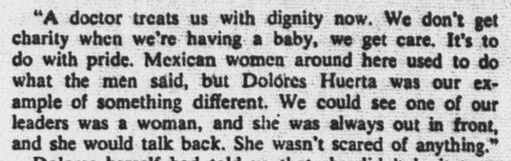
Ester Yurande, a UFW member in 1974, was inspired by Huerta’s example: “Mexican women around here used to do what the men said, but Dolores Huerta was our example of something different. We could see one of our leaders was a woman, and she was always out in front, and she would talk back. She wasn’t scared of anything.”
A Champion for Marginalized Communities
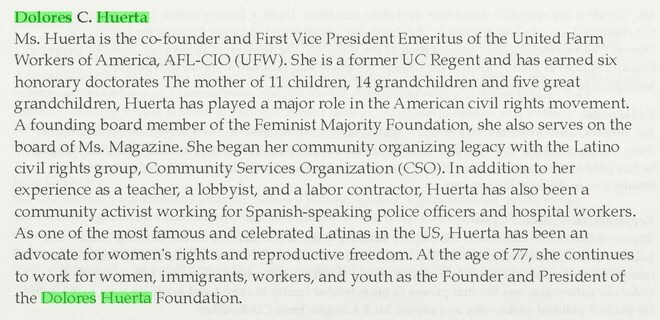
Reference Materials – Latino/as: biographical sketches. 2008. MS Flora Rodriguez Russel Papers, 1945-2008: Series 1 Professional, 1946-2002: Reference Materials, 1948-2002 WH2458 Box 5 Folder 16. Denver Public Library. Latino Social and Political Culture and History, https://link.gale.com/apps/doc/JDIYPX599605437/LSPC?u=virta&sid=bookmark-LSPC&xid=8cc74837&pg=1
This biographical sketch from a 2008 Colorado Latina/o Advocacy Day shows just how impressive Huerta’s accomplishments were, even at 77 years young. She was a champion for marginalized communities and was not afraid to step up to help whenever the need arose. Huerta was a proponent of grassroots organizing, and of holding public officials accountable through community organizing, collective action, and voting. She was a staunch fighter for social justice who earned respect through her tireless leadership and activism. Huerta’s legacy can be seen in the many individuals and organizations that took inspiration from her words and deeds and found the courage to stand up and say “Sí, se puede!”
If you enjoyed this post about the activism of Dolores Huerta, you might like:
- Exploring Latino History through the Chicano Movement
- Lost (and Found) in Translation: Language in Archives of Latin American and Caribbean History
- Global Communist and Socialist Movements – The Third Instalment of Political Extremism and Radicalism
- Pride and Protest: LGBT+ Disability Activism in the US, 1985-1995
- “Power to all the people or to none”: Grassroots activism in amateur publications written by women, African Americans and the LGBT+ community
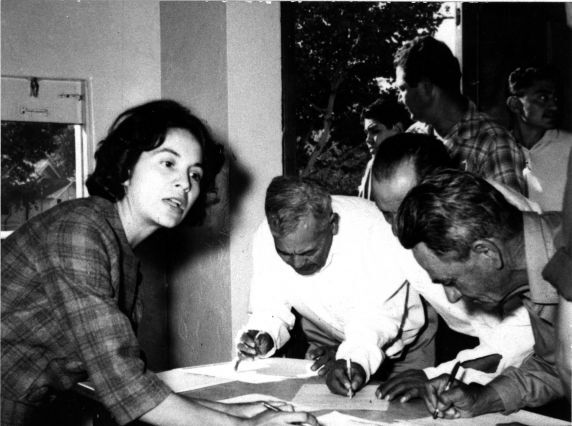
Blog post cover image citation: Dolores Huerta signs up new members at the founding convention of the National Farm Workers Association (NFWA), Delano, California. National Farm Workers Association (NFWA), Convention, Dolores Huerta, September 30, 1962. Photographer: Joseph Gunterman. Accessed at https://reuther.wayne.edu/node/175