
│By Eleanor Leese, Acquisitions Editor, Gale Primary Sources│
As we approached a significant milestone in the life of Eighteenth Century Collections Online – the launch of Part III in March 2026 – I found myself minded to go looking for significant milestones inside the archive itself. And what more significant milestones are there than births, marriages, and deaths? But what I found in ECCO Part III weren’t emotional tracts about these major life events. Instead, I found tables of mortality data, and an eighteenth-century specialty: the insurance of births, marriages, and deaths. Turns out, there’s little that you couldn’t insure in the 1700s.
In the first decades of the eighteenth century, insurance policies developed into a thriving financial marketplace, where policies could be taken out on homes, fire damage, on the birth of a baby, the length of a marriage or apprenticeship, or the length of a life.
Life Insurance and Friendly Societies
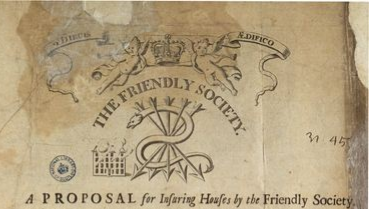
The eighteenth century was a time of financial innovation and new financial services. Unlike in today’s more regulated systems, the line between gambling and insurance was hazy at best, and often non-existent in practice. The first ‘friendly society’, or life insurance scheme, was created in 1696, and was designed to alleviate the suffering of working class widows who might otherwise be left in poverty following the death of their husband.1
This feels somewhat similar to the life insurance policies we are familiar with today, where it is accepted practice that you might pay into a life insurance scheme to ensure financial stability after the death of a family member or a loved one.
But life insurance in the eighteenth century was not as familiar as this first example might suggest. Although there were systems for accurately estimating life expectancy and survival rates at different ages, life insurance policies were not generally calculated investments based on the expected survival or age of death of the insured party.
Instead, they operated as lotteries, with all parties paying into a scheme that would pay out to a beneficiary whose death was considered more a matter of chance than of mathematics or science. Rather than a carefully calculated insurance premium based on individual risk factors, the cost to enter a scheme was the same for every participant, as was the size of any payout. For many schemes, members paid an initial entrance fee, a regular stipend to cover administrative costs, and were expected to make additional payments if and when any payouts were made from the scheme.
The Gambling Act of 1774
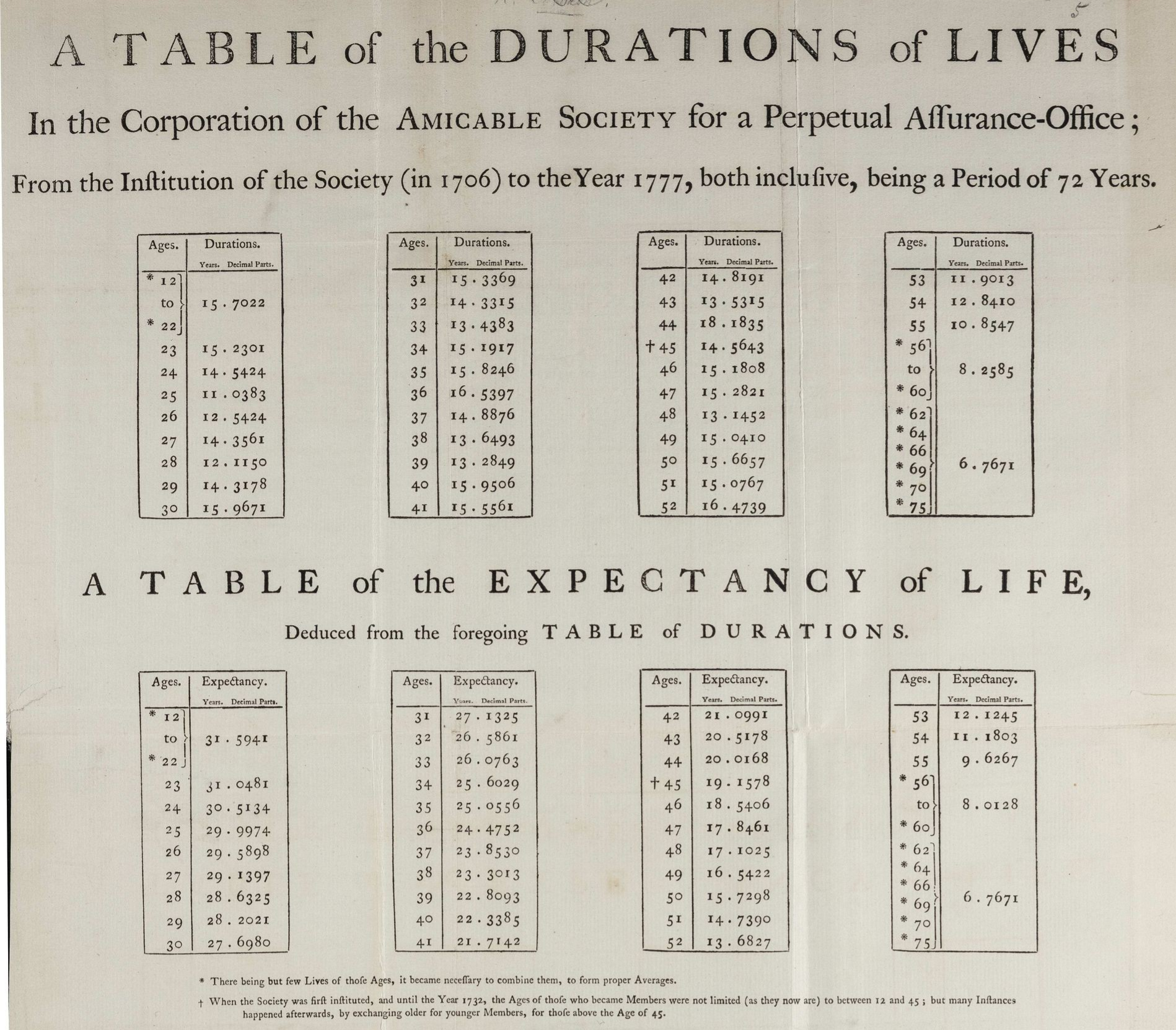
Until the Gambling Act of 1774 was introduced, there were no restrictions on who could insure a person’s life. Meaning, in effect, that anyone could insure anyone’s life, standing to make a profit if they were to die in the term of the policy. Following the Gambling Act, life insurance policies changed considerably. It was no longer possible to insure someone with whom you did not have a financial interest, and as we see from this table of the durations of lives below, insurance became more individualised.
Marriage Insurance
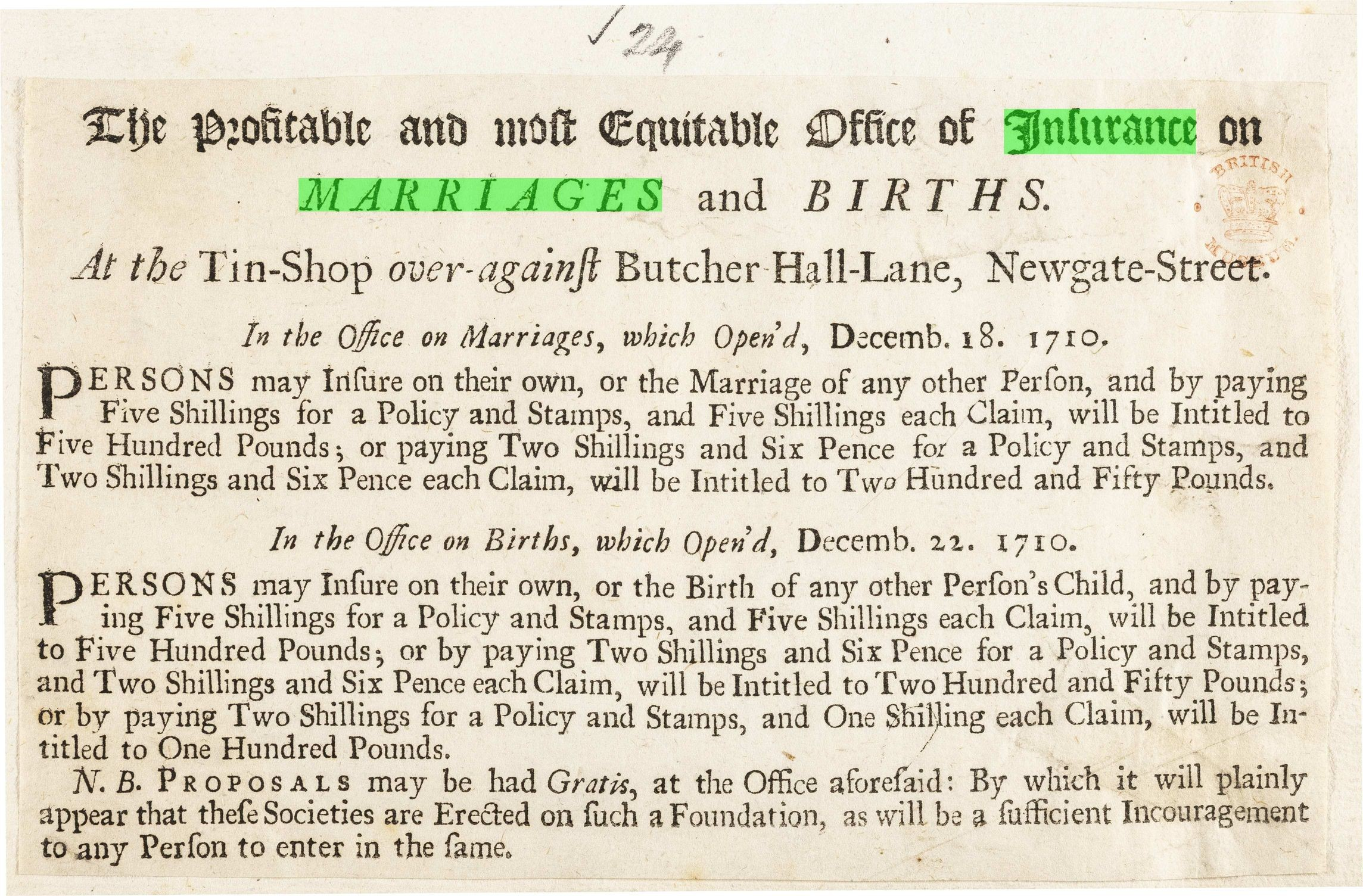
Lives and deaths weren’t the only things that could be insured in the 1700s. This advertisement from 1710 shows a range of insurance products on offer, including insuring marriages and births. These insurance policies were essentially bets on whether a marriage or birth would take place in a given time frame, usually a matter of weeks or months, from the taking out of the policy.
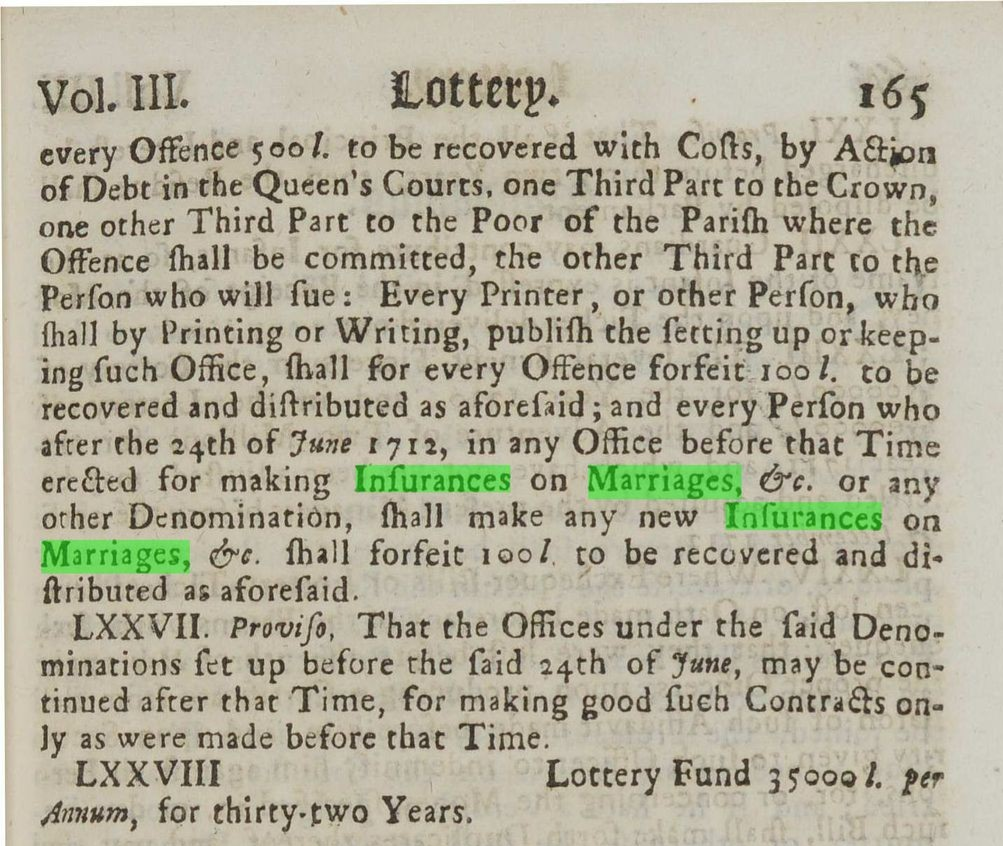
The proliferation of new insurance schemes caused considerable concern on moral grounds, because it was seen as a form of gambling. In 1711, a law was introduced to ban the practice of insuring marriages and births, with a hefty fine for anyone found to be running a scheme.
This was not sufficient disincentive for some enterprising individuals, as we see a strengthening of the law in later months. The financial penalties for running such schemes were severe – a fine of £500. There was a fine for printing or publishing materials relating to a scheme, showing the pivotal role of the printing trade in the proliferation of these schemes too.
A Growth of Rationality
What do these short-lived but significant innovations in the business of insurance tell us about the eighteenth century? We see in these novel financial products an attempt to place a value on human life – to quantify the unquantifiable. We can connect this desire to the growth of ‘rationality’ throughout the period, and the gradual replacement of religious explanations with scientific proofs.
Where in previous times the survival of a marriage or a husband was a mystery that could not be understood by mortals, the increasing focus on understanding the natural world to be one that was governed by observable principles demystified popular thinking about life and death.
With the range of materials available in Eighteenth Century Collections Online, and especially with the addition of new materials in Part III, we can see the development and ultimate collapse of this new market for birth, marriage, and death insurance throughout the century. From its early days as a new, potentially profitable financial product, through moral concerns and prohibitive laws, to a life insurance offering that feels more familiar to a contemporary reader, we get a sense of the changing sensibilities throughout this uniquely revolutionary century.
If you enjoyed reading about the eighteenth century and insurance policies, check out these posts:
- Glam Rock to Georgian Riots: Bowie’s Last Notebook
- ECCO’ing through the Ages: Exploring Reception with Gale’s Eighteenth Century Collections Online
- An Eighteenth-Century Intersectional Feminist? Exploring the Life of Lady Mary Wortley Montagu in Eighteenth Century Collections Online
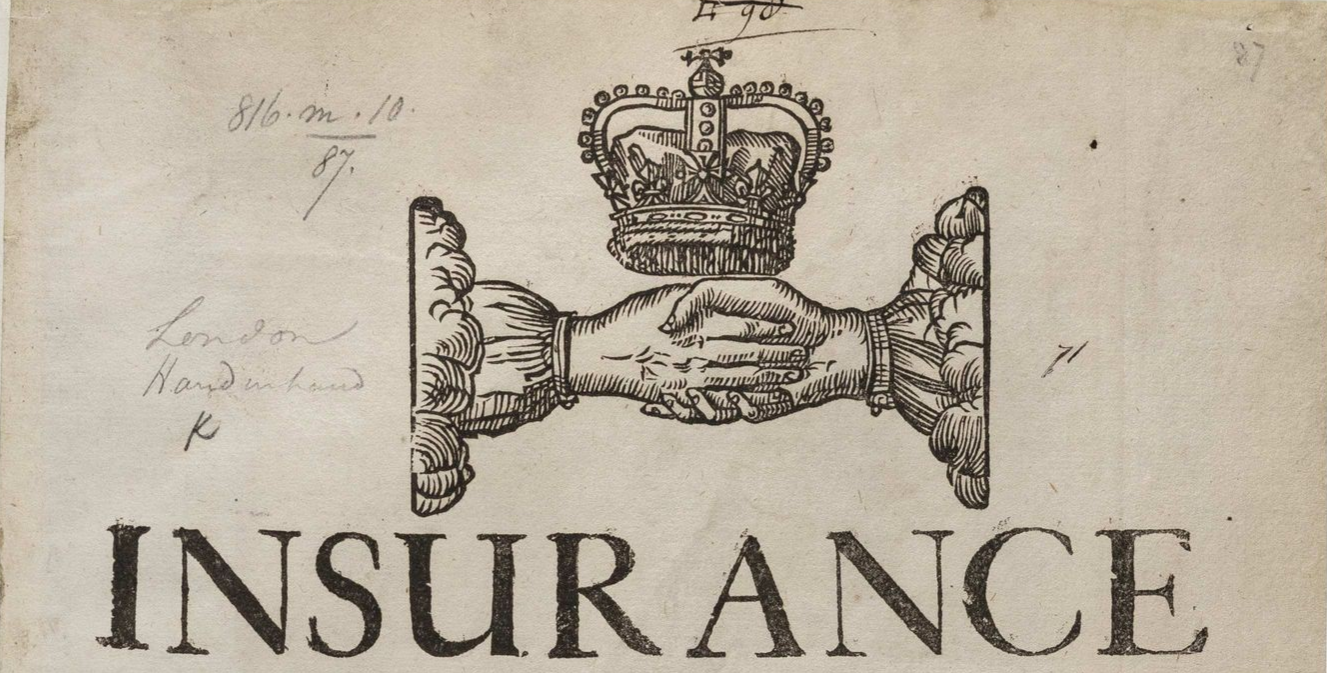
Blog post cover image citation: Hand-in-Hand Fire Office. Insurance from loss by fire. By the Amicable Contributors, at Tom’s Coffee-House in St. Martin’s-Lane, near Charing Cross, where attendance is daily given. [s.n.], [1730?]. Eighteenth Century Collections Online, https://link.gale.com/apps/doc/PPQWOM370890425/ECCO?u=webdemo&sid=bookmark-ECCO&xid=967ceba9&pg=1.