

│By Sofía Sanabria de Felipe, Gale Ambassador at the University of Oxford│
With great power comes great responsibility. With being a doctoral researcher comes the ever-present question: what do you work on? As a response, you come up with an elevator pitch that somewhat does justice to your project. To do so, you find yourself using abstract terms like ‘universality’ and ‘contingency’, often leaving your audience none the wiser as to what exactly it is you do.
So, when Gale Primary Sources offered me the opportunity to write a blog post centred on my research, I decided to use their archives and digital humanities tools as a way of finally perfecting my elevator pitch.
Selecting the Archives
Doing any historical research means delineating temporal parameters. My research focuses on the reception of a 1764 text, Immanuel Kant’s Observations on the Feeling of the Beautiful and the Sublime, in the aftermath of the Napoleonic Empire in French-speaking Europe, up until the 1848 revolutions.
I look at how different figures – artists, art critics, mathematicians, even military instructors – used the epistemological frameworks (that is, language and ideas) offered by Kant’s work to address their contemporary, material anxieties.
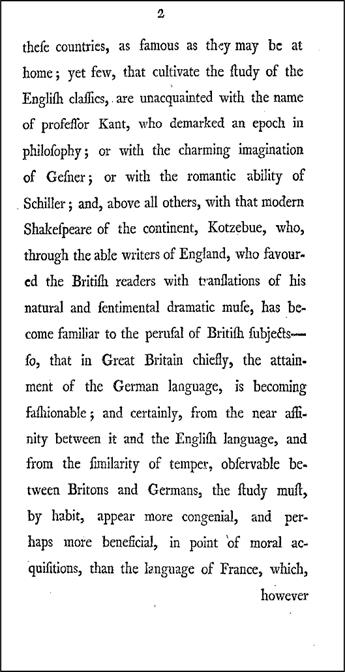
My research therefore exists somewhere between the eighteenth and nineteenth century, constantly exploring similarities between the two. Both the 1760s and 1820s-1840s were periods of political instability, with regime changes and policies of exile often making it difficult for intellectual figures to have a stable, one fits-all model or set of ideas and principles that could be readily applied to contemporary circumstance.
Luckily for me, Gale Primary Sources has two greatly organised archives corresponding to these two periods: Eighteenth Century Collections Online and Nineteenth Century Collections Online, immediately making my research into a tumultuous time a much smoother ride.
Exploring the Archives
As my work centres on the reception of intellectual concepts from the eighteenth into the nineteenth century, coming up with a short list of the key topics circulating at the time becomes crucial in narrowing down the premise of my research.
Luckily for me, Gale’s archives all come with a Topic Finder function, which runs through the archives and identifies key themes, displaying them in either a colourful panel of tiles or wheels. These displays are not just visually informative, they’re interactive! Clicking on any one of the tiles/sections of the wheels immediately breaks down a theme into sub-concepts, always linking back to specific sources within the archives to explore further.

From Topic Finders to Research Questions
Looking at the two tile visualisations, the core epistemological topics or concerns in both periods seem to focus on gender, spirituality, the role of the church, correspondence between different intellectual figures, the legacy of the classical world, education and, as highlighted by the red colour, the art world and its permeation into other areas of life.
A breakdown of the ‘Art’ topic from Nineteenth Century Collections Online demonstrates the importance of the francophone world to the intellectual configuration of the period, as well as the role of women within these spaces, as shown by tiles such as ‘gentlewoman’ and ‘exhibitions’. Under the topic of ‘Answers’, the archive highlights the value awarded to aesthetics in this period as a vehicle for resolving the biggest questions of this time.

I cannot begin to express how vindicated this tile arrangement has made me feel, for my research question explores how three key intellectual figures of the time (Auguste Hilarion comte de Kératry, Humbert de Superville and Adolphe Quetelet) utilised the language and frameworks of aesthetics to guide (or better still, educate) the next generation of citizens so that they would be adequately prepared to stabilise Europe and hopefully fulfil the intellectual aspirations that had been laid out in the 1760s.
These processes of education took place, as the tile visualisation reflects, in a number of places (from military academies to religious institutions and universities), but it was the exhibition and salon cultural space that stood out. Exhibitions and salons were open to a wide public, and it was up to art critics to guide these large audiences not just through the artworks, but rather through the emotional landscapes the works embodied.
This therefore highlights how the resolution of contemporary anxieties were a collective, shared exercise, necessarily conducted through the language and material medium of aesthetics.
The Relevance of ‘Enlightenment’ and ‘Modernity’ as Categories of Analysis
When people ask about my research, they often try to understand it through two main concepts: Enlightenment and Modernity. While preliminary research into archives shows the importance of aesthetics to these periods – and by extension to my work – most people would think of these two other movements/ideas/processes. While there is a growing challenge to the homogeneity of these terms, the post-Napoleonic period is still mostly explained away in their terms; either as precursor to the latter, or a simple, straightforward extension of the former.
A quick search for ‘enlightenment’ within Nineteenth Century Collections Online interestingly reveals negative results, suggesting that while there is an undeniable reception of this movement’s ideas in the post-Napoleonic period, it is not linguistically configured using that terminology. The concept of modernity, though not present as a key topic of the archive, does appear once the search function on the topic finder tool is refined.
It’s crucial to highlight, though, that the sources a search on modernity brings up are dominated by references to the art world – and to a French one at that! From references to art critics and their reviews, to in-depth explorations of London and Paris as centres of aesthetic expression, modernity is broken down in this archive into subsections which further reify the material complexity and fluidity of the nineteenth century.
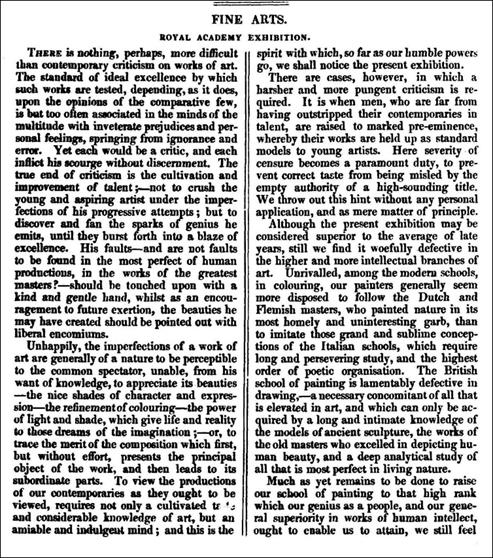
Instead of neat categories of periodisation, the search for modernity and enlightenment within these archives prompts us to refine our parameters, to search for the language used at the time to make sense of these periods. Using the Topic Finder function helps support the leading argument of my research: that aesthetic frameworks from the 1760s played a substantial role in addressing contemporary anxieties of the 1820s-1840s. Challenging the dominance of enlightenment and modernity in intellectual history is a key dimension of my research.
Articulating the rationale behind this has always been tough in an elevator pitch, especially as enlightenment and modernity are well-known principles. Often, I wish I could explain my research in those terms – it would certainly make communicating my research that much easier! However, with Gale Primary Sources and its visual, analytical tools, I can finally be truthful to my figures and their languages, no longer having to compromise the nuance of my work for the clarity an elevator pitch requires.
If you enjoyed reading about Intellectual History, and the eighteenth and nineteenth centuries, check out these posts:
- ECCO’ing through the Ages: Exploring Reception with Gale’s Eighteenth Century Collections Online
- An Overview of the Romantic Period Using The Times Literary Supplement Historical Archive
- ‘Who knows to suffer, Conquer, and to Save’ – Scottish Romanticism and the Jacobites
- Fashion and the Eighteenth-Century Public Sphere: from Tatler to Twitter