
│By Eleanor Turner, Gale Ambassador at the University of Leeds│
Declassified Documents Online: Twentieth-Century British Intelligence offers unique insight into how governments understand and respond to global security threats. The emergence of nuclear weapons in 1945 fundamentally altered the structure of international politics, leading governments to rethink what military conflict could escalate to and the devastating consequences of deploying nuclear weapons. Declassified Documents Online: Twentieth-Century British Intelligence shows how the British government strategised to overcome these changes.
Identifying the Threat
As nuclear weapons were a relatively new technology in the twentieth century, there was uncertainty about the effects of the destructive weapons. Therefore, a key factor that the British intelligence was examining was the uncertainty associated with nuclear weapons, specifically the exact capabilities of nuclear weapons, the speed of progress from rivals, and the size of future stockpiles. In addition, there was uncertainty about miscalculations – what if a state misinterpreted a threat, or a technical fault released the weapons?
As a result, intelligence often assumed the worst-case scenarios in order to prepare and plan for all possible outcomes. This helped governments plan, but was exhaustive, difficult to work out, and increased the likelihood of fear and instability.
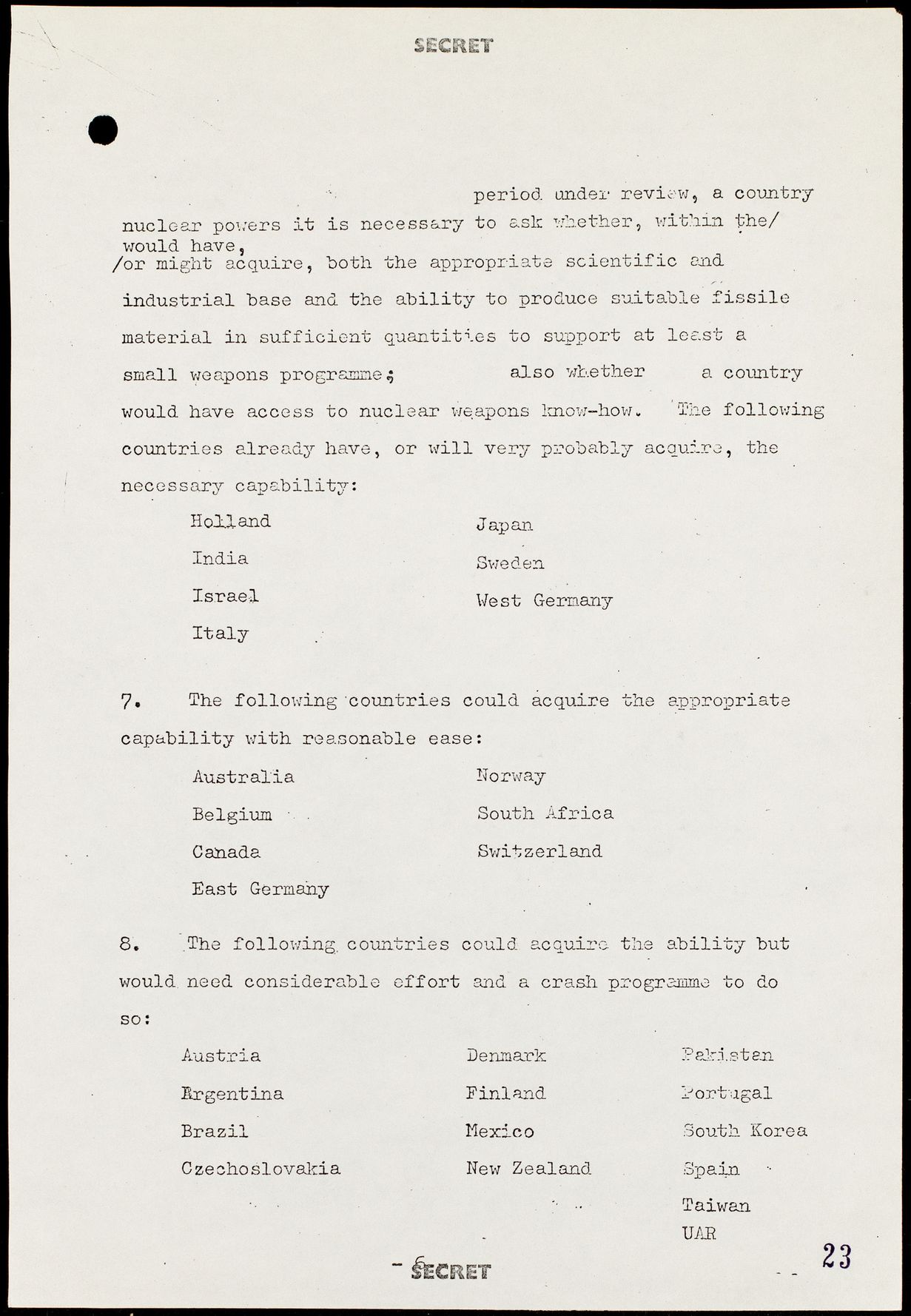
The atmosphere of uncertainty was not desirable. UK Nuclear Deterrent Working Group papers show that a foundational true assumption that could be relied upon was created to mitigate this uncertainty. One of these was where the threat may originate from. Therefore, the nuclear threat was framed by perceiving that certain states would not use nuclear weapons on the UK, and others were more likely to. This narrowed down the focus of analysis to a primary adversary, thus creating frameworks and policies that were more certain and reliable.
Alliances, Rivalries, and Selective Threat Perception
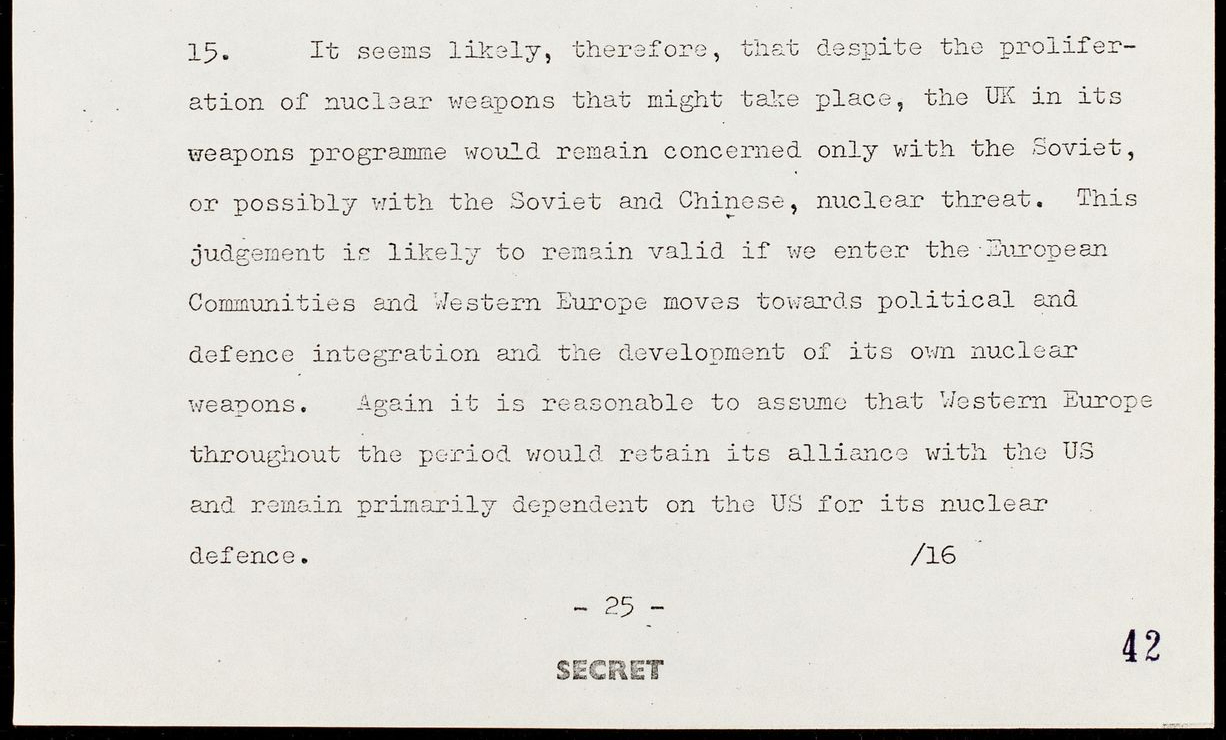
Interestingly, these papers show that not all threats were seen as equal. In theory, any state carrying a nuclear weapon should have been a threat, but it was not. This is due to alliances and geopolitics. For example, despite Britain fighting two World Wars against Germany earlier in the century, the threat was not held as highly about the prospect of German nuclear weapon development. Instead, the primary concern rested with the Soviet nuclear armament – the UK was said to ‘remain concerned only with the Soviet’.
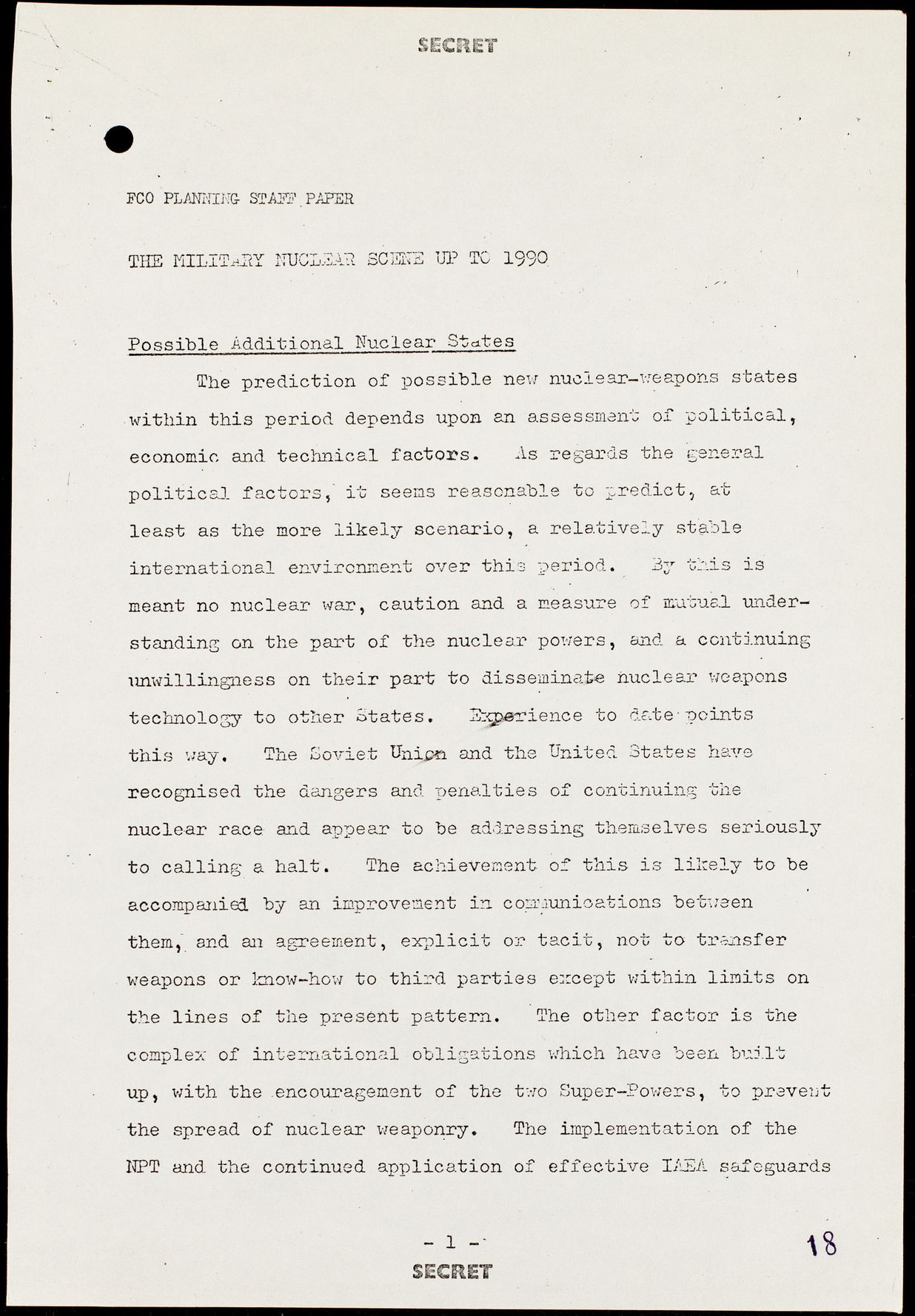
This shows some degree of selectivity in interpreting the danger of nuclear weapons and highlights the importance of ideological rivalry and geopolitical factors.
The Nuclear Paradox
Although Soviet nuclear capability was clearly viewed as a major threat, the papers also reveal an important paradox: nuclear weapons were not always interpreted as purely destabilising. This document states that nuclear weapons will lead to a ‘relatively stable international period’ because ‘the Soviet Union and the United States have recognised the dangers and penalties of continuing the arms race’.
Because nuclear weapons have the ability to create extreme levels of damage and incite retaliation, this is not desirable for either side. This shows that global security is not just about producing powerful weapons and using them, but also about seeing if these weapons can coexist peacefully.

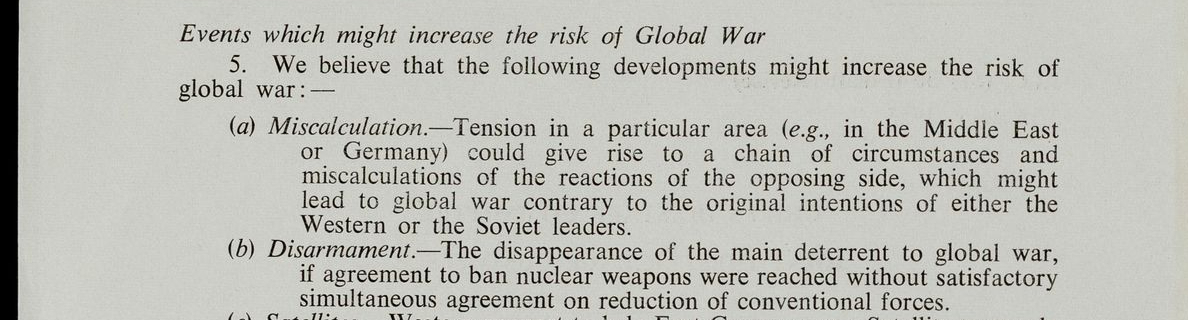
This logic can be seen again in discussions around disarmament: ‘Disarmament.—The disappearance of the main deterrent to global war, if agreement to ban nuclear weapons were reached without satisfactory simultaneous agreement on reduction of conventional forces.’
It suggests that, paradoxically, intense weapons of mass destruction may even bring peace to other forms of conflict by dissuading states from military disputes in case it escalates into warfare where nuclear weapons are used. Thus, nuclear weapons become a safeguard against other conflicts, providing one argument as to why there has not been nuclear disarmament even today.
Consequently, this suggests that despite the threat and uncertainty of nuclear weapons, there is an acceptable threshold of nuclear risk that is permissible because these weapons act as a deterrent for global war. To some extent, the nuclear weapon is transformed from a threat into a strategic equilibrium due to the shared vulnerability but also shared consensus that a nuclear war is unwinnable.
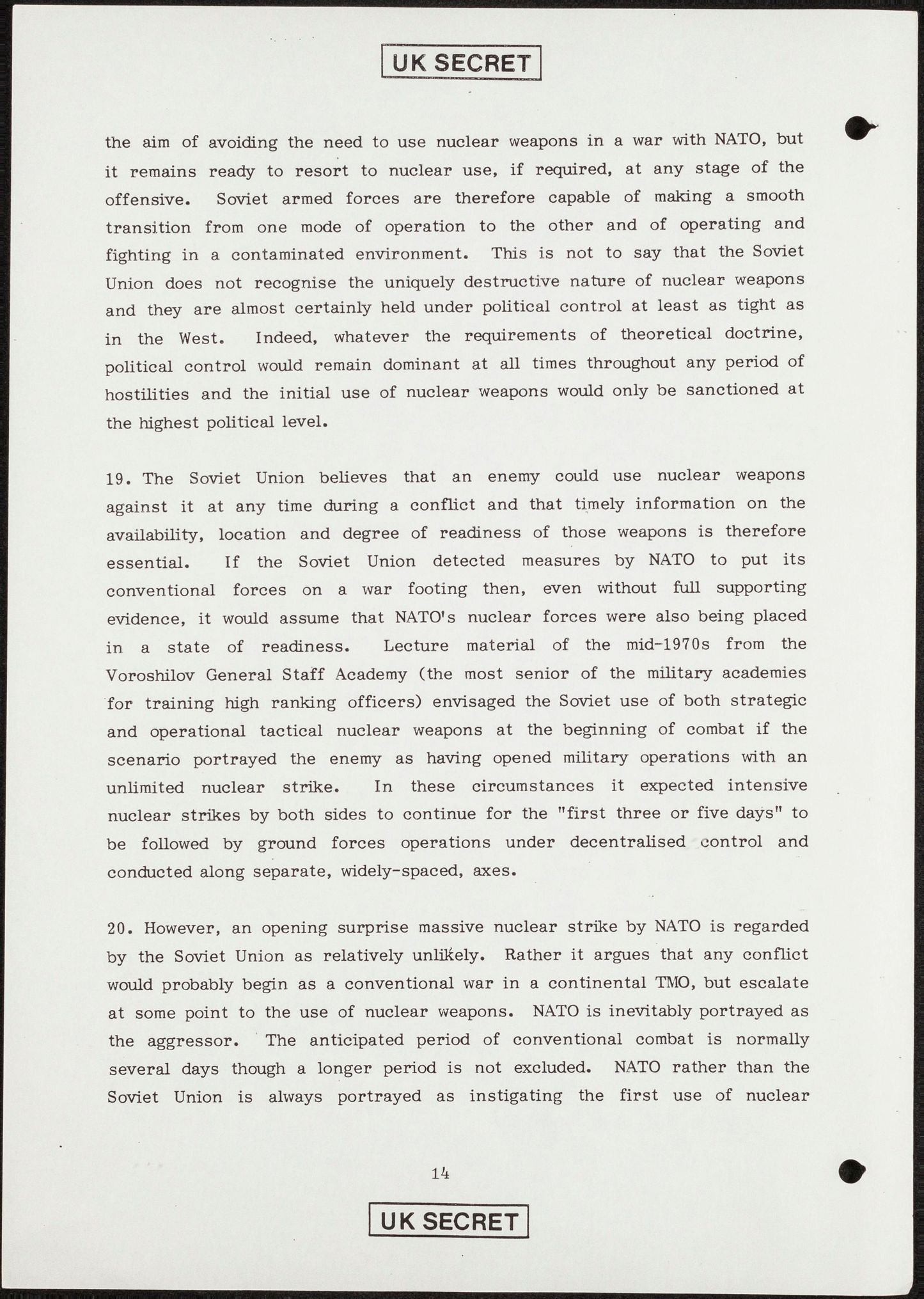
It is important to note that by 1985 the British government did not see the Soviets as likely to use nuclear weapons first; if that information had changed, then so would this equilibrium. This perception helped settle discourse on nuclear war. But it was not promised. Had this perception been different, and intelligence suggested that the Soviets were likely to launch an attack, then security theories would have looked very different.
This teaches us that security is not fixed. Instead, in this case, there was a fragile harmony between rival states about their shared vulnerabilities and that nuclear war is unwinnable.
This shows that global security is not just shaped by how an objective threat looks at face value, but how it can be interpreted and politically managed. There is some success to this as neither side has used nuclear weapons, and there have not been any additional world wars; however, how stable you perceive this period is subjective.
Interpreting the Bomb
Ultimately, declassified nuclear history reveals that global security responses are shaped less by objective threats and more by how danger is interpreted, debated, and politically managed. The threat of nuclear weapons at the beginning of their conception was enshrouded in uncertainty and fear; over time, there seems to be a nuanced understanding that they can be used strategically.
If you enjoyed reading about this, check out these blog posts:
- Reimagining Global Politics: International Relations through a Non-Western Lens
- Soviet agricultural experiments, hibernation, the bomb, and other curious facts behind Science Fiction stories
- Declassified Documents Online: Twentieth Century British Intelligence, Monitoring the World
Blog post cover image citation: a collage of images from the archive.