
| By Alice Shadbolt, Gale Ambassador at the University of Liverpool |
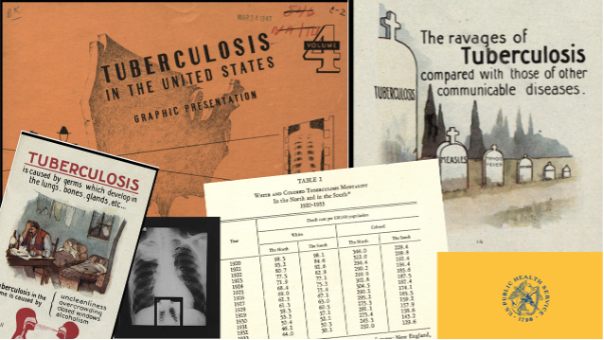
Between 1915 and 1940, tuberculosis posed one of the most urgent public health crises for North America and Europe. However, its impact was far from evenly distributed. In the United States, mortality rates amongst Black communities were consistently higher than those recorded amongst white Americans, a disparity that became a central preoccupation of contemporary public health discourse.
Drawing on Gale’s Public Health Archives, which preserves the reports, policy documents, and educational materials produced by municipal and state health departments, this post examines how these institutions approached and explained this disparity. A close reading of these documents reveals how language was strategically deployed to redirect responsibility onto Black communities themselves, pathologising race and obscuring the lived implications of racial inequality.
These silences are as illuminating as the statistics. The archive functions not only as a passive repository of public health history, but as a case study into the construction of official narratives, demonstrating what is emphasised, what is reshaped, and what is forgotten. By tracing these patterns, this post highlights both the political nature of public health language, and the value of reading archival materials for what they refuse to discuss as well as what they say.
Inequality in America’s Tuberculosis Crisis
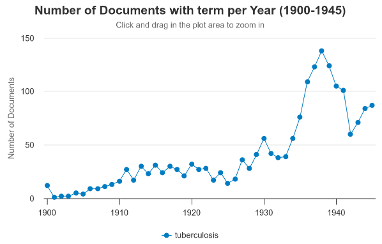
Emerging as one of the most prolific killers in the Western hemisphere in the early-twentieth century, tuberculosis maintained a constant presence within public health discourse. This is reflected in Gale’s Public Health Archives.
The rising frequency of the term tuberculosis between 1900 to 1940 illuminates how the disease increasingly preoccupied government health departments, placing sustained pressure on public health systems.
However, the crisis was rendered more complex by its uneven distribution. Contemporary records demonstrate that officials were forced to confront a stark disparity. In some regions, rates of mortality amongst Black Americans were recorded as up to seven times higher than those of white populations.
Tables and statistics, such as the one featured below, categorised cases using terms such as “Negro” and “Coloured”, language now recognised as deeply offensive, but which reflected the classificatory practices and racial attitudes of early-twentieth-century society.
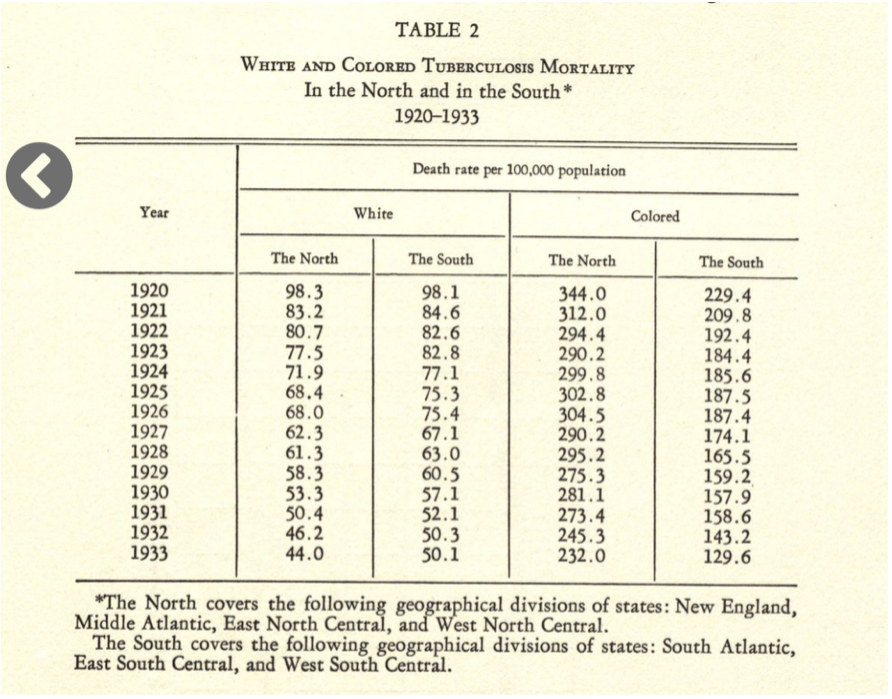
Before turning to how these statistics were interpreted, it is important to recognise that this documentation immediately foregrounded race as a primary lens through which tuberculosis was understood. By presenting the disease as having a distinctly racialised dimension from the outset, these reports shaped the framework within which official explanations were constructed and racialised narratives evoked.
Pathologising Race and the Demonisation of Black Communities
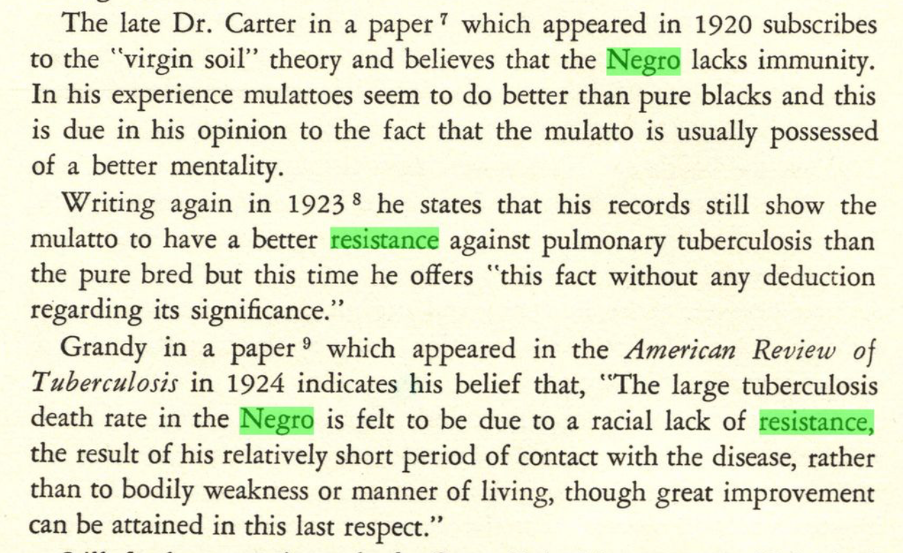
In attempting to explain this stark disparity in mortality rates, public health authorities drew on two interconnected lines of argument. The first evoked Enlightenment era pseudo-scientific racial theory to present Black bodies as biologically inferior and thus more susceptible to disease.
In a pamphlet produced by the National Tuberculosis Association and U.S Public Health Service, officials claimed that Black Americans possessed a “racial lack of resistance” and suggested that those of mixed heritage were better equipped to withstand infection due to their whiter heritage and “better mentality.” Such assertions were framed as objective fact. The use of scientific studies and technical, clinical language such as “proliferation and dissemination of the bacilli” worked to lend authority to unfounded racist ideology.
Alongside this biological framing, official institutions relied on moral and behavioural explanations to cast Black communities as responsible for their own ill-fortune. The same report asserted without citation that “one in five Negro tuberculosis patients has syphilis”, attributing high rates of venereal disease to stunted recovery.
In foregrounding claims of sexual irresponsibility amongst Black communities, officials drew on deeply entrenched racial stereotypes to demonise Black behaviour, deflecting attention and responsibility from structural responsibility.
The Benevolent Framing of Government Public Health Action
Public health reports framed government interventions as strikingly benevolent, and as “guardians of the Negro” dutifully protecting a population depicted as both vulnerable and irresponsible. This paternalistic language reinforced a clear hierarchy, where Black Americans were depicted as lacking the skills to safeguard their own health, leaving white authorities to fill the gap.
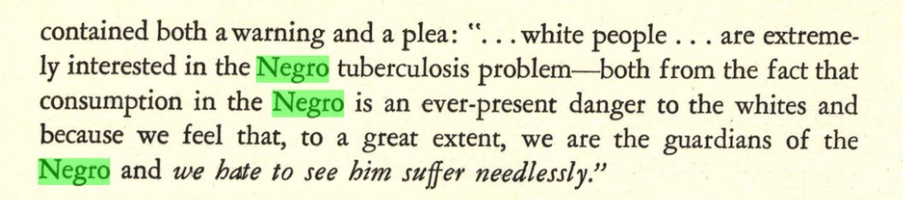
This benevolence was further emphasised through detailed accounts of government action within archival documentation. These included targeted education campaigns, the expansion of sanatorium beds available to Black patients, and the training of Black healthcare workers.
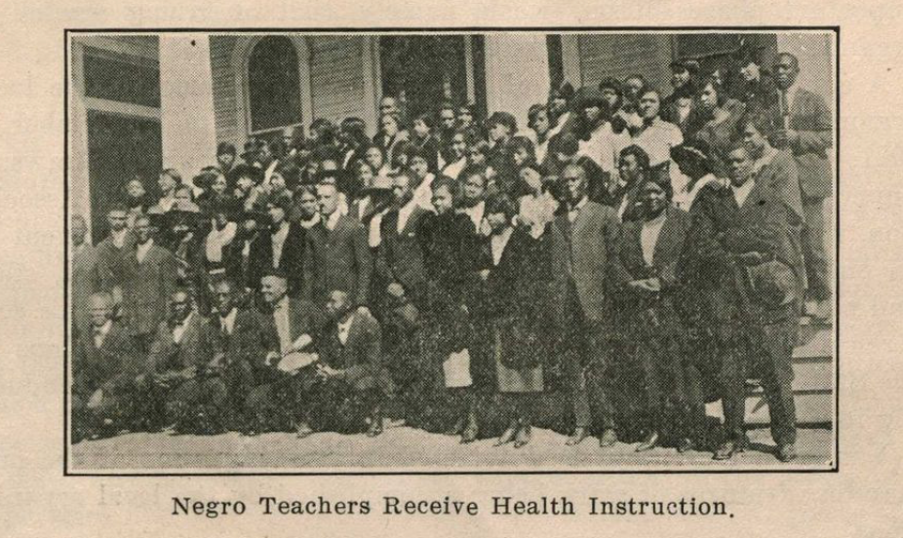
These initiatives were presented as generous and substantial investments of state resources. This rhetoric, in tandem with the demonisation of Black communities, functioned as a strategic narrative device that obscured the crises’ real foundations. In foregrounding care and instruction, state institutions diverted attention from the structural inequalities and racial hierarchies that rendered tuberculosis particularly devastating for Black communities.
The Erasure of Structural Inequalities
Whilst public health authorities devoted considerable attention to racialised explanations of tuberculosis, they obscured the structural conditions that shaped vulnerability to disease. Tuberculosis spread most rapidly in overcrowded housing and communities facing chronic poverty.
These conditions disproportionately affected Black Americans who were systemically excluded from stable employment, adequate housing, and social mobility. Yet these realities were almost entirely absent from public health discourse.
This omission becomes clear when analysing the framing of public health policy action. Public health nurses were tasked with teaching improved diet and hygiene amongst Black communities.
Distributed posters acknowledged overcrowding and uncleanliness as factors, emphasising individual responsibility. At no point did this approach acknowledge that these were not chosen circumstances, but the outcomes of the racial hierarchy deeply embedded in the social and economic fabric of early-twentieth-century America.
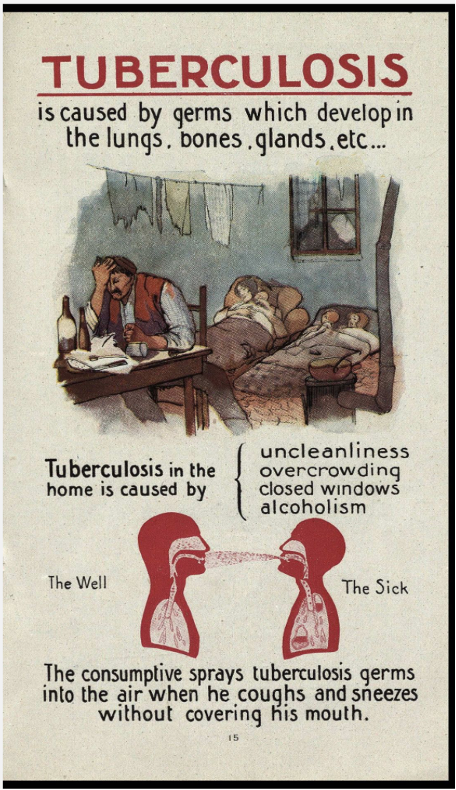
Ultimately, the combined linguistic framing of demonisation and benevolence in public health discourse worked to marginalise the lived reality of Black Americans. In deflecting attention from the structural inequalities that made tuberculosis so devastating, racial hierarchies could persist as unchallenged.
Tracing Racial Hierarchies
The materials preserved in Gale’s Public Health Archives reveal how language shaped official understanding of tuberculosis and obscured the inequalities that truly shaped its impact. By attending to both what the documents emphasise and what they marginalise, we can trace how racial hierarchies were reinforced through public health discourse. Reading these silences and omissions is essential for understanding how power operates within the historical record.
If you enjoyed reading about the racial framing of tuberculosis, check out these posts:
- The Homophobic Response to the AIDS crisis in the 1980s
- Spanish Flu in the time of COVID-19
- Birth Control: A History in Women’s Voices
Blog post cover image citation: A montage created from the following Wikimedia sources:
https://commons.wikimedia.org/wiki/File:Flag_of_the_United_States_Public_Health_Service.svg
https://commons.wikimedia.org/wiki/File:1939_X-ray_of_active_tuberculosis_condition.jpg
Combined with sources used in this blog post.