
│By Elizabeth Hameeteman, Postdoctoral Researcher, Technische Universität Berlin │
When I began my Gale Fellowship, I was curious about how digital tools might support my historical research. As someone trained primarily in archival and text-based methods, I was eager to explore how computational approaches might offer new ways of seeing familiar materials – or even lead me to sources I wouldn’t have encountered otherwise. What I didn’t expect was that it would shift the trajectory of my work entirely.
Desalination as a Development Tool
My original case study, Salty Business, set out to further explore how desalination – the process of turning sea or brackish water into fresh water – became a developmental tool in both colonial and postcolonial contexts. Long imagined as a way to harness the ocean’s vast potential, desalination gained traction in the postwar decades as part of broader efforts to drive national development and state-building, particularly in arid and semiarid regions. While the technology advanced rapidly after World War II as part of high-modernist visions of progress, its earlier history and role as a developmentalist model remain largely overlooked. My goals were to trace how colonial powers like the United Kingdom, France, and the Netherlands promoted desalination in their overseas territories, and how newly independent states such as India, Tunisia, and Indonesia later adopted it to secure water as a foundation for sovereignty and economic growth.
At the core of this inquiry were questions that intersected the histories of science, environment, and infrastructure: Why did desalination become an attractive technology for these governments? What promises did it carry? And how did it circulate – technically, politically, and discursively – across vastly different geographies, from the Mediterranean to the Indian Ocean?
The Gale ESEH Non-Residential Fellowship
The Gale ESEH Non-Residential Fellowship in Digital Environmental History gave me the opportunity to explore such questions using digital methodologies. With access to Gale Primary Sources – including Environmental History: Colonial Policy and Global Development, Nineteenth Century Collections Online, and Gale Historical Newspapers – I began assembling a broad, comparative foundation of materials that allowed me to explore desalination from multiple angles. I could now compare newspaper reporting, government documents, and institutional publications across time, place, and language, giving my work a wider scope than would have been feasible using print archives alone.
Gale Digital Scholar Lab added another layer of discovery. Tools like Named Entity Recognition, Ngram, and Topic Modeling helped me trace how desalination was discussed and imagined over time and across regions – mapping not only what was said, but also who was doing the talking, and where. I was able to identify recurring terms – such as “modernization,” “technical cooperation,” and “development”—and explore how their use shifted across different colonial and postcolonial contexts. It allowed me to examine thematic patterns in how desalination was framed, and importantly, where it was absent from the record.
But the most transformative part of the Fellowship wasn’t simply collecting data or experimenting with digital tools – it was what emerged between the lines.
Unexpected Discoveries
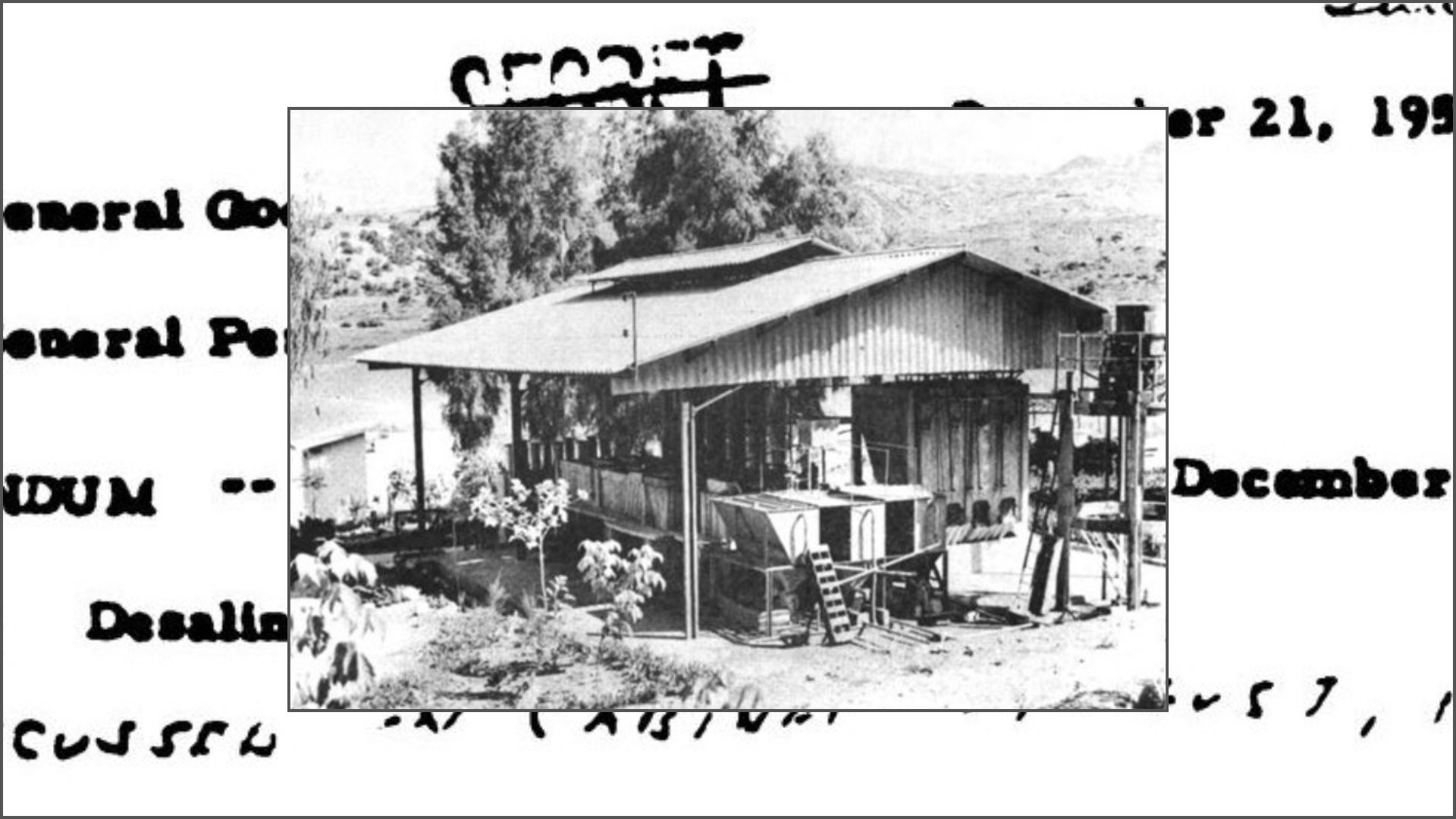
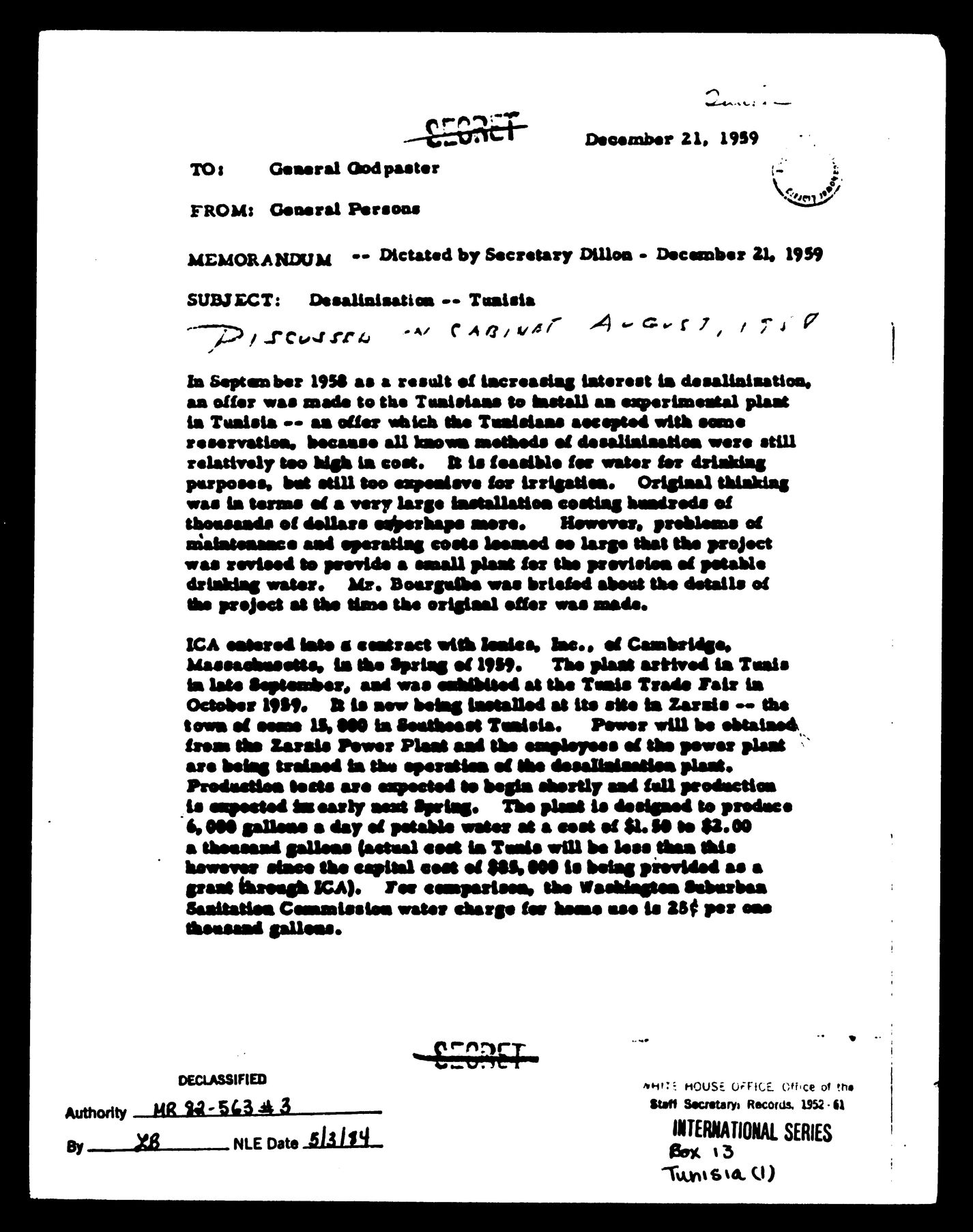
While working with Gale’s resources, I came across several unexpected yet compelling sources – not directly tied to my original case study, but highly relevant to my broader research. One particularly striking discovery was a 1959 White House memo on a desalination project on the island of Djerba in Tunisia. I was familiar with the project, but this document shed new light on the extent of U.S. involvement. It prompted me to further consider the political motivations behind desalination initiatives in newly independent states, and how Cold War-era scientific diplomacy and development priorities shaped technological choices in the Global South. That memo has since found its way into a journal article I’m currently finalising, based on my dissertation.
Even more significantly, this discovery helped spark a broader realisation: solar desalination – a once-promising but ultimately sidelined technology – remains critically underexplored. Unlike fossil-fuel and nuclear-powered systems, solar methods stayed largely experimental and underfunded, despite their clear potential for sun-rich, water-scarce regions. This wasn’t just a technological oversight; it reflected deeper priorities in international development discourse where scalability and compatibility with existing energy infrastructures often outweighed consideration of local appropriateness or sustainability.
The Fellowship helped me identify the historical marginalisation of solar desalination as a compelling new direction of research – one that connects environmental history with questions of postcolonial equity, energy justice, and technological choice.
Reflect, Reframe and Refocus
Although I haven’t yet used Gale’s tools specifically for this emerging work, the Fellowship gave me the space to reflect, reframe, and refocus. I’m currently in the midst of launching a dedicated study on the role of solar desalination in postwar development, particularly in postcolonial contexts like North Africa. Despite its technical promise and suitability for arid regions with abundant sunlight, solar desalination was often absent from postwar development planning, funding priorities, and international policy discussion – reflecting broader biases toward centralised, large-scale technologies and the geopolitical agendas shaping development choices in the Global South. I hope to return to Gale’s archives with this refined focus and explore how digital tools might help trace not only the presence but also the absence of solar desalination in international development discourse.
An Expanded Digital Humanities Skill Set
Beyond the immediate gains for my wider research, the Fellowship has also reshaped how I approach methodology. Working with large historical datasets and interpreting computational outputs in context expanded my digital humanities skill set – skills I’ve begun integrating in both teaching and future projects. More importantly, it made me more attuned to historical silences: the gaps, omissions, and overlooked alternatives that shape the technological landscapes we inherit. It also deepened my curiosity about how digital tools might help surface what’s missing – not just what’s visible.
In this sense, the Fellowship didn’t just help me analyse desalination – it helped me imagine the solar futures that might have been and could still be. It reminded me that technologies don’t just evolve; they are chosen, promoted, and often, strategically ignored.
The Gale Fellowship didn’t just support a project – it supported a pivot. It helped me ask new questions, spot overlooked narratives and carve out space for an environmental history that is both technically grounded and politically attuned. I’m grateful for the opportunity and look forward to seeing where this evolving research takes me next.
If you enjoyed reading about the intersections of development, technology, and postcolonial state-building, check out:
- Decolonization: Politics and Independence in Former Colonial and Commonwealth Territories
- Reimagining Global Politics: International Relations through a Non-Western Lens
- A Window into Decolonization: Perspectives from Formerly Colonised and Commonwealth Regions
And if you’re interested in environmental history, you may like:
- The Mystics of Environmental History and Ethnobotonical Research
- The First Module in Gale’s Environmental History Series – Conservation and Public Policy in America, 1870-1980
- New Environmental History Archive: Colonial Policy and Global Development, 1896-1993
Blog post cover image citation: Solar field testing in Algeria, in U.S. Department of the Interior, “Third Annual Report of the Secretary of the Interior on Saline Water Conversion” (January 1955), 123, HathiTrust. Available online: https://babel.hathitrust.org/cgi/pt?id=uc1.b4123557&seq=136