
│By Lindsay Whitaker-Guest, Associate Editor, Gale Primary Sources│
Gale Primary Sources has recently released its latest addition to the groundbreaking series China and the Modern World. China and the Modern World: The English Language Press in China, 1827-1974 features 25 English-language newspapers and periodicals published over the course of 150 years of immense change and transformation in China.
These newspapers and periodicals played a significant role in the cultural and political life of major Chinese cities, offering critical and diverse reporting on milestone events. In this post I will delve into these newly digitised titles and discuss some of the stories and insights which can be researched through this unique new resource.
Trading Tensions in Canton
The first English-language newspaper printed in China was the Canton Register, founded in 1827. Published fortnightly, it catered primarily to foreign merchants working in Guangzhou (Canton) under the restrictive Canton System. Its pages included everything from commodity prices and ship arrivals to commentary on Chinese society and trade practices, revealing how foreigners understood and navigated life in Qing China.
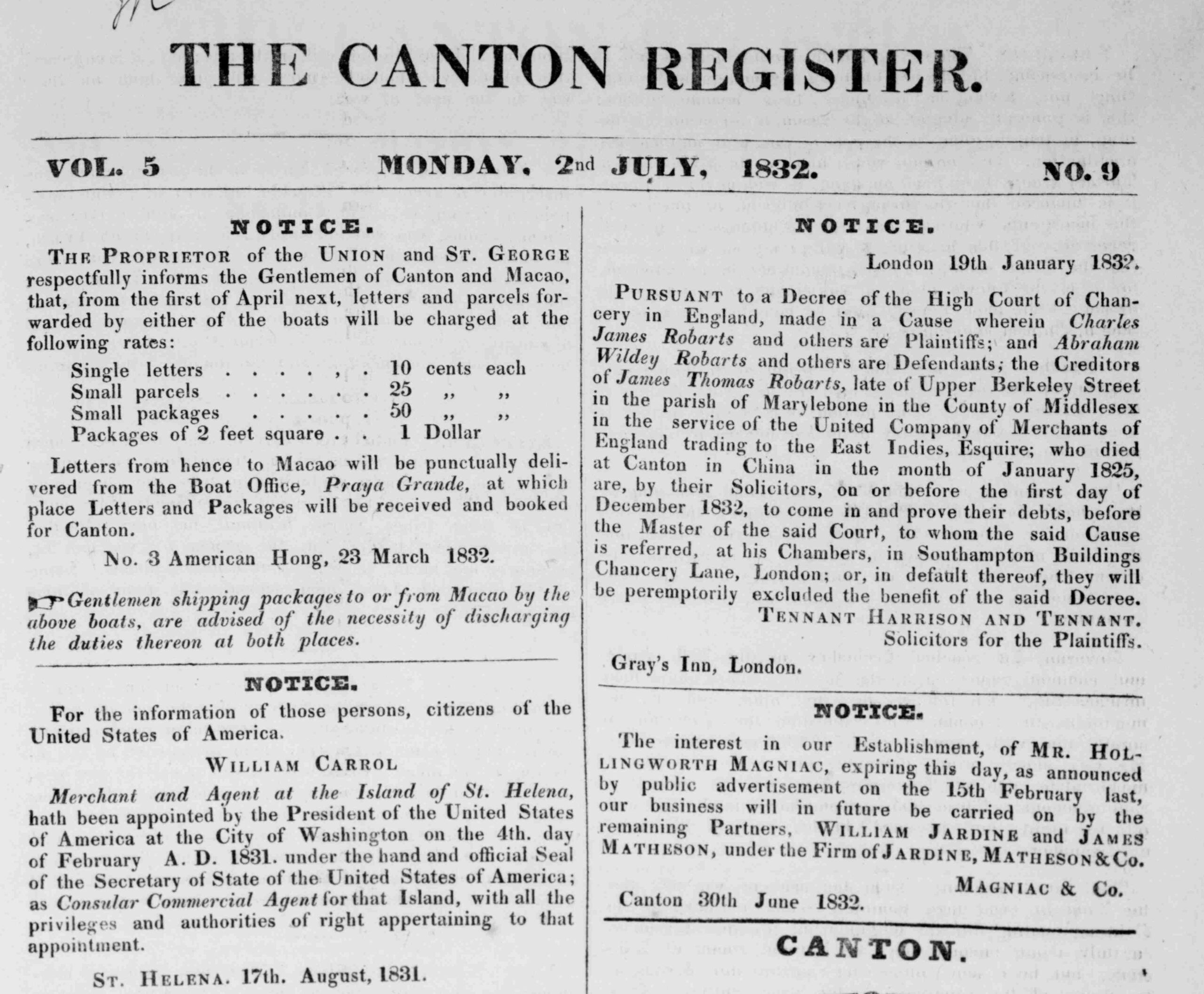
One of the backers of the Canton Register was James Matheson, founder of Jardine, Matheson and Company, which traded tea, silk, cotton, and opium out of Canton. Its formation in July 1832 was announced in the newspaper.
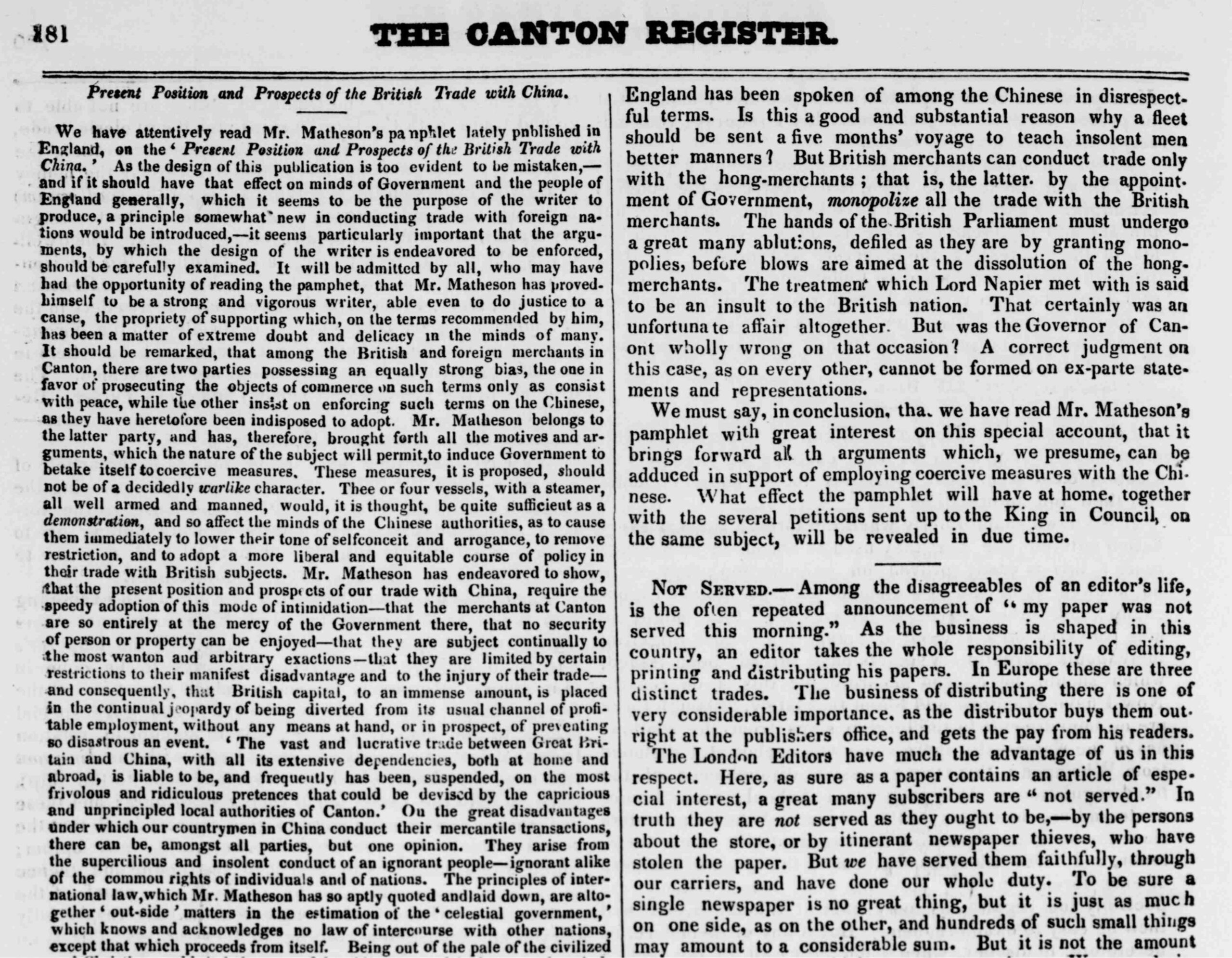
Unsurprisingly, with Matheson as a funder the paper often advocated for an end to trading restrictions under the much-maligned Canton System. This Qing policy restricted foreign merchants to Guangzhou, tightly limiting their trading rights. An 1836 article, for example, praised a pamphlet by Matheson that criticised Chinese “arrogance” and recommended the use of armed ships to pressure China into reforming its trade policies.
Tensions over trade culminated in the outbreak of the First Opium War in 1839. Many British ships used early in the conflict were leased from Jardine, Matheson & Co., which by then had become the region’s largest opium trader. The Canton Register provides a revealing window into the commercial motivations and ideological arguments that helped shape British policy in China.
Treaty Ports and the Expansion Into Hong Kong
The First Opium War ended when the Chinese and British signed the Treaty of Nanking in 1842. The Treaty ceded Hong Kong to Britain and opened five Chinese cities or treaty ports – Canton (Guangzhou), Amoy (Xiamen), Foochow (Fuzhou), Shanghai, and Ningpo (Ningbo) – to foreign trade as well as forcing China to pay a crippling indemnity. The agreement, later known in China as the first of the ‘unequal treaties’, transformed the landscape for foreign merchants and sparked significant expansion in English-language publishing.
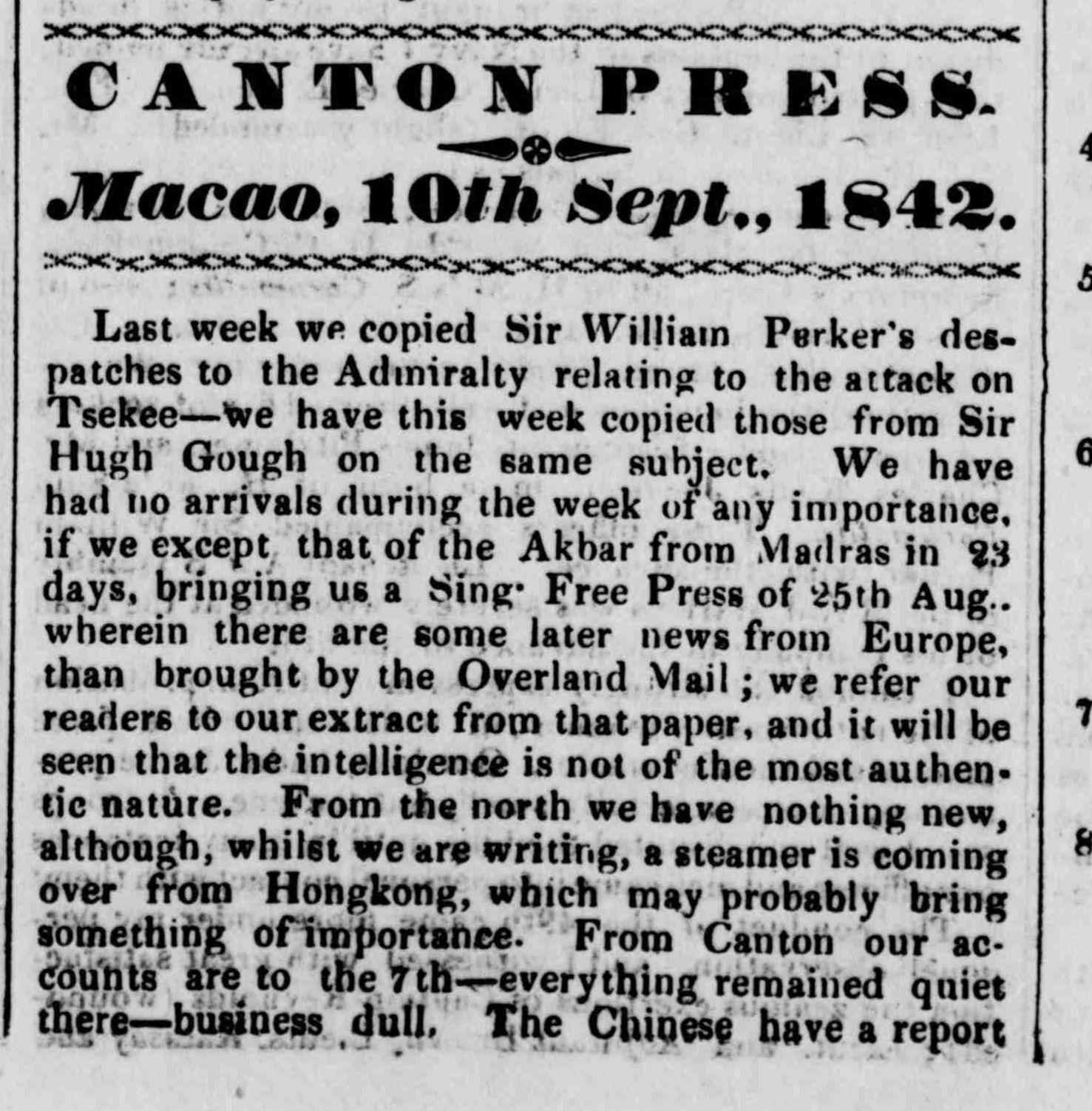
The Canton Press, celebrated news of the treaty, calling it “glorious” and claiming that it offered “room for the satisfaction of all claimants.” The enthusiasm underscores the British mercantile priorities, often in stark contrast to Chinese reactions of humiliation and national crisis.
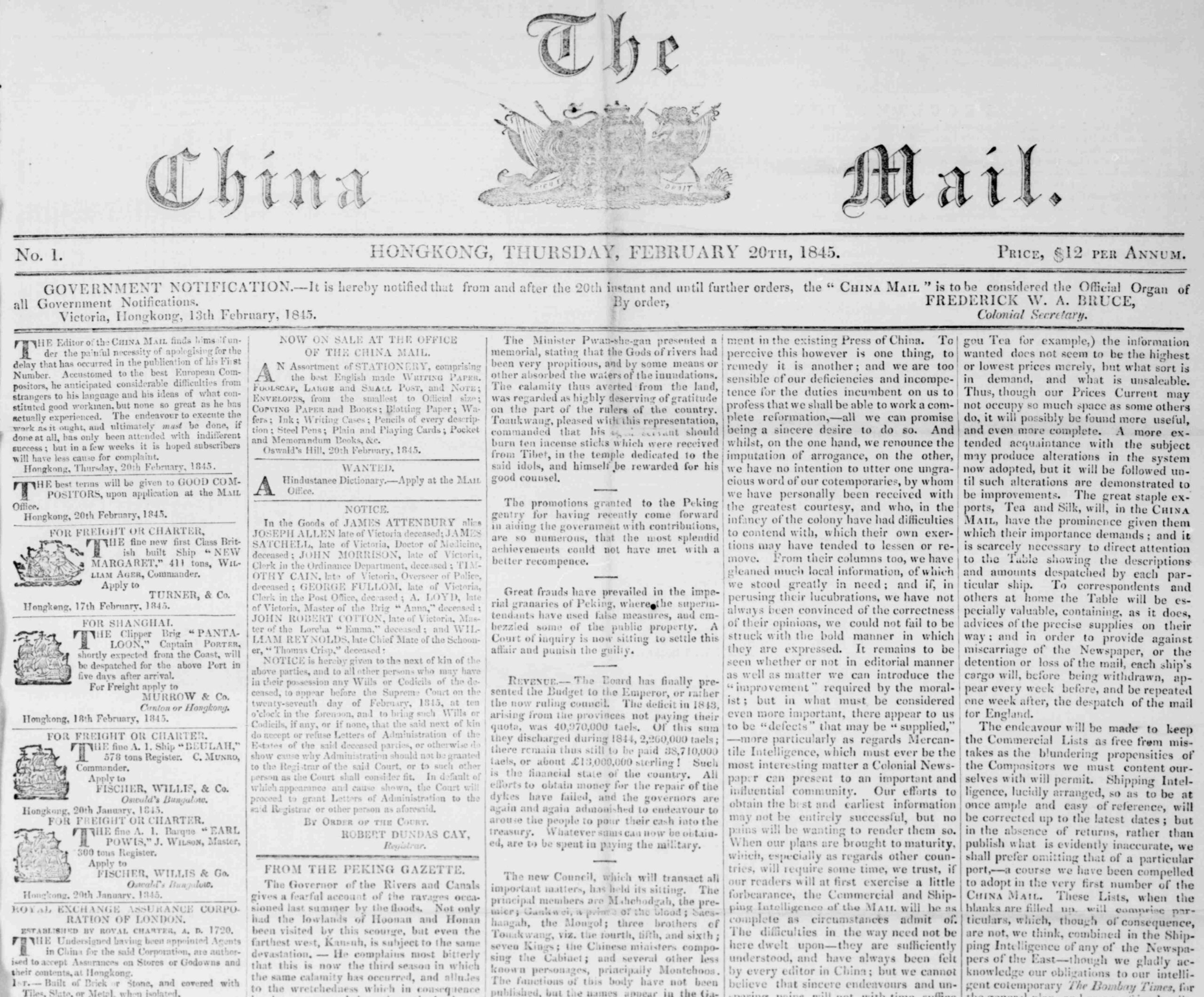
The ceding of Hong Kong led to an expansion in the English-language press, and The China Mail, published from 1845 until 1974, emerged as one of the most influential titles. Like others, the paper served the interests of the trading community. The first issue of the paper promised that “the Commercial and Shipping Intelligence of the Mail will be as complete as circumstances admit of” and that “our own opinions; which until matured by further knowledge and experience of the colony, we cannot flatter ourselves will carry much weight”.
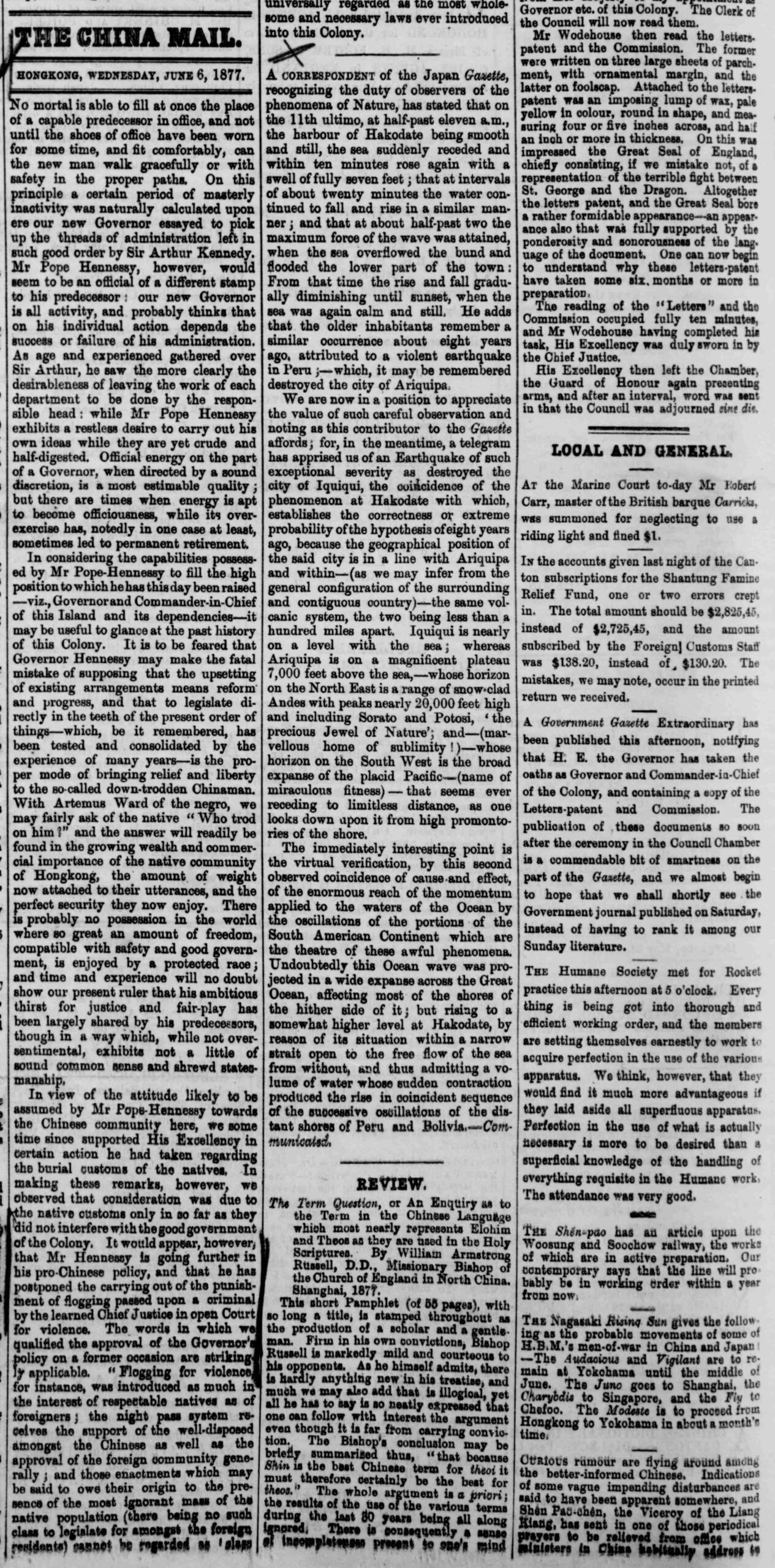
By the 1870s, The China Mail had become far more politically assertive. In an 1877 editorial, it criticised Governor John Hope Hennessy’s more conciliatory policies toward the Chinese, describing his ideas as “crude and half-digested” and warning him of the consequences of altering laws considered “wholesome and necessary.” Such commentary reveals how English-language newspapers often championed the interests of the colony’s business elite and resisted reforms that threatened established hierarchies.
Reporting on the Boxer Rebellion
By the late nineteenth century, English-language newspapers had spread well beyond the treaty ports. In northern China, the Peking and Tientsin Times, founded by British architect William H. Bellingham, provided foreign residents with regional and international news from a decidedly British perspective.
The paper’s coverage of the Boxer Rebellion (1899–1901) is particularly revealing. The uprising led by the Society of Righteous and Harmonious Fists, known as ‘boxers’ due their practice of martial arts, began as a reaction against foreign influence and missionary activity but escalated into a broad anti-imperialist movement.
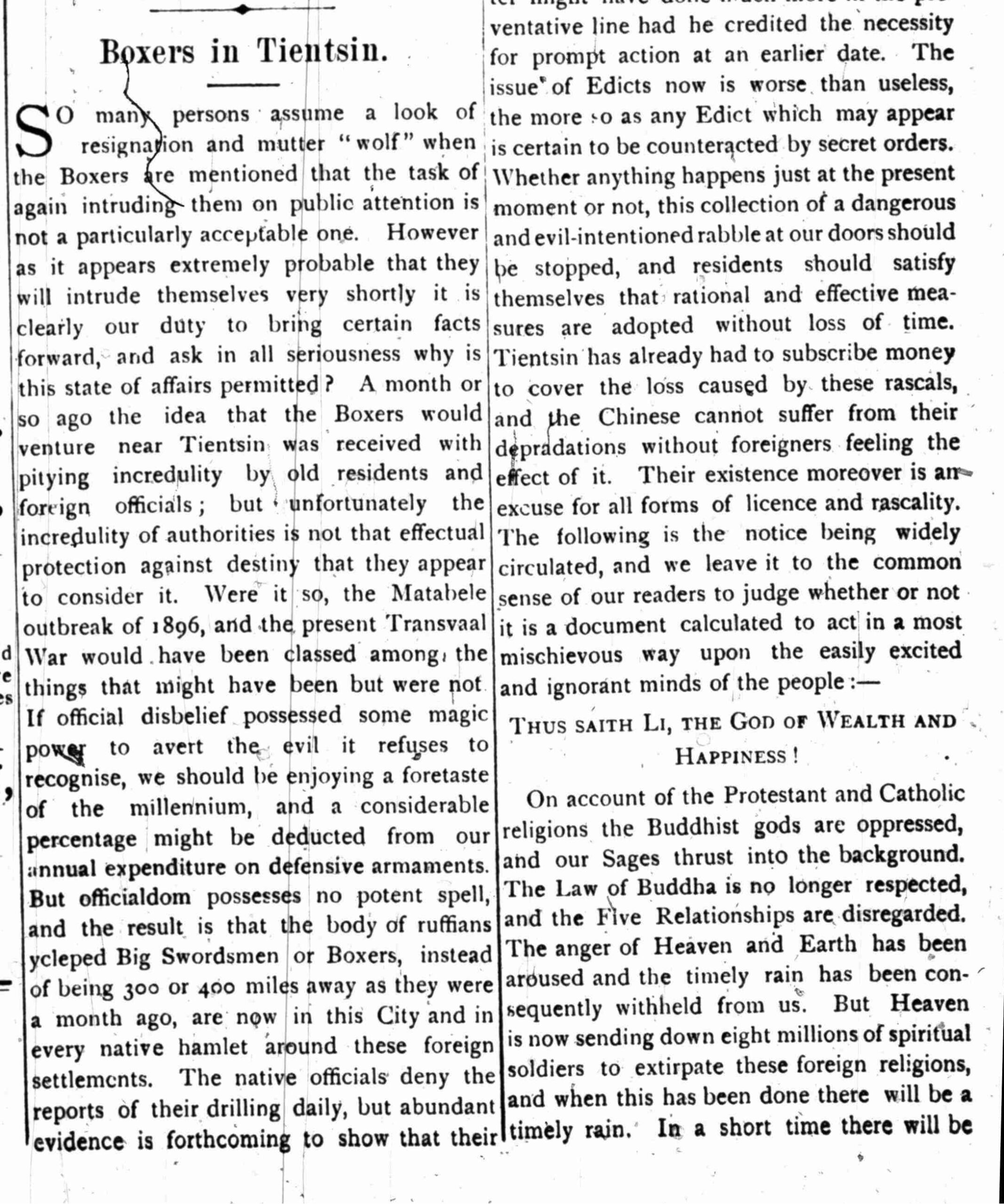
A March 1900 article described the Boxers as “reckless and lawless rascals” and warned that they were approaching Tientsin to recruit men sworn to “drive out the foreigners.” The paper criticised Qing officials for failing to suppress the unrest, even suggesting they were quietly supporting the movement.
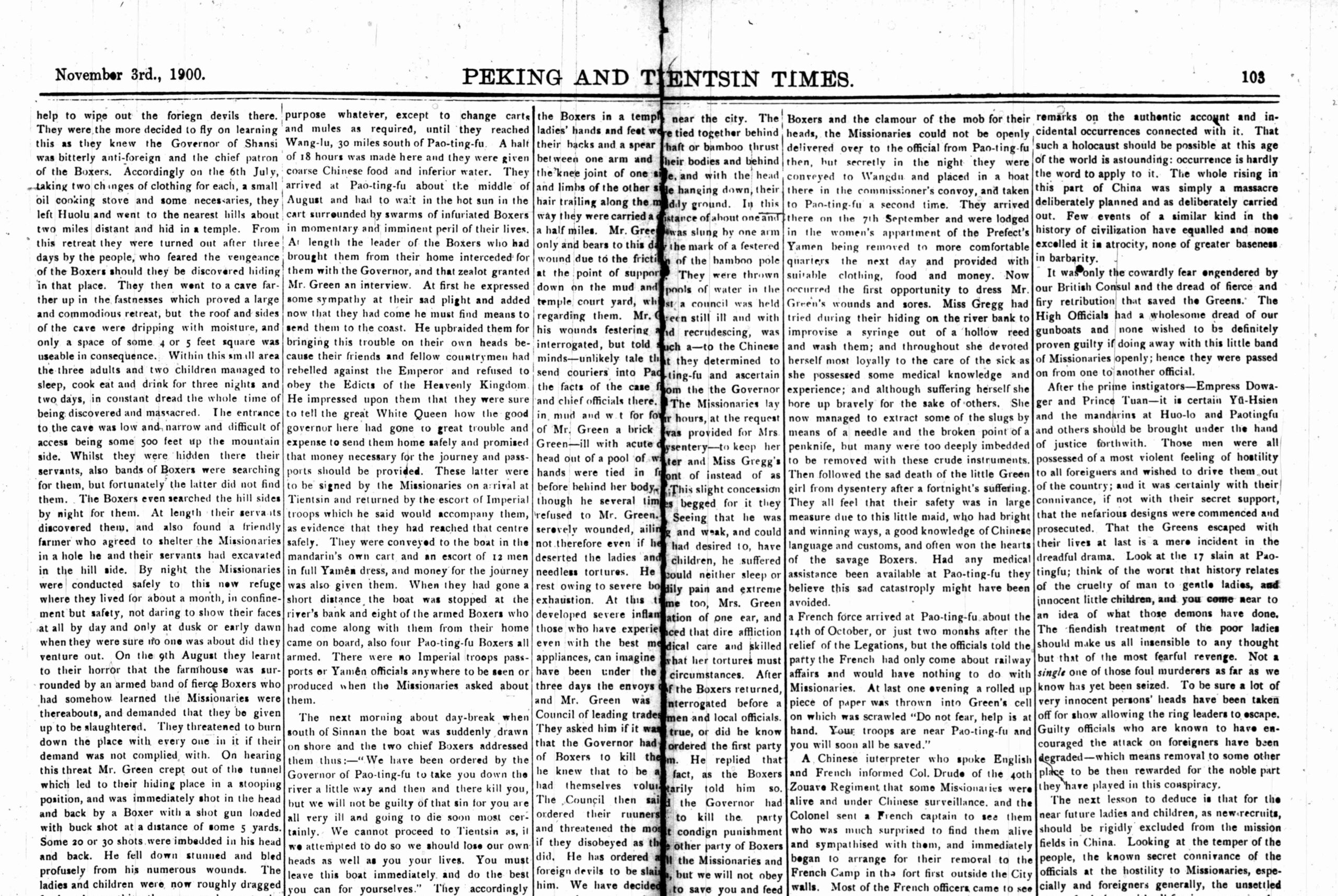
By November 1900, the conflict had intensified dramatically. Missionaries were attacked and killed across northern China. The Times reported the brutal ordeal of the Green family, who were “dragged from the house by the hair of the head” and forced on a long journey on foot, eventually fleeing to safety. Sadly, their young daughter died of dysentery during the escape. Accounts like these were widely circulated in foreign newspapers and helped shape Western public support for the Eight-Nation Alliance’s intervention.
Twentieth-Century Conflict: China and Japan
The twentieth century brought new forms of conflict, most notably the growing tensions between China and Japan. After Japan’s invasion of Manchuria in 1931, relations deteriorated rapidly. On 7 July 1937, Japanese troops claimed a soldier had gone missing near Wanping, south of Beijing. Fighting broke out when they demanded entry to search for him – a confrontation that became known as the Marco Polo Bridge Incident.
!["Nippon Statement." North China Star, vol. 19, no. 331, 9 July 1937, p. [1].](https://review.gale.com/wp-content/uploads/2025/12/north-china-star-1937_Page_1_cropped-scaled.jpg)
The North China Star, an American-owned daily published in Tianjin, reported the event by printing official statements from both Chinese and Japanese authorities. Each side accused the other of provoking the clash, and the paper’s decision to present both narratives reflects an attempt at balance.
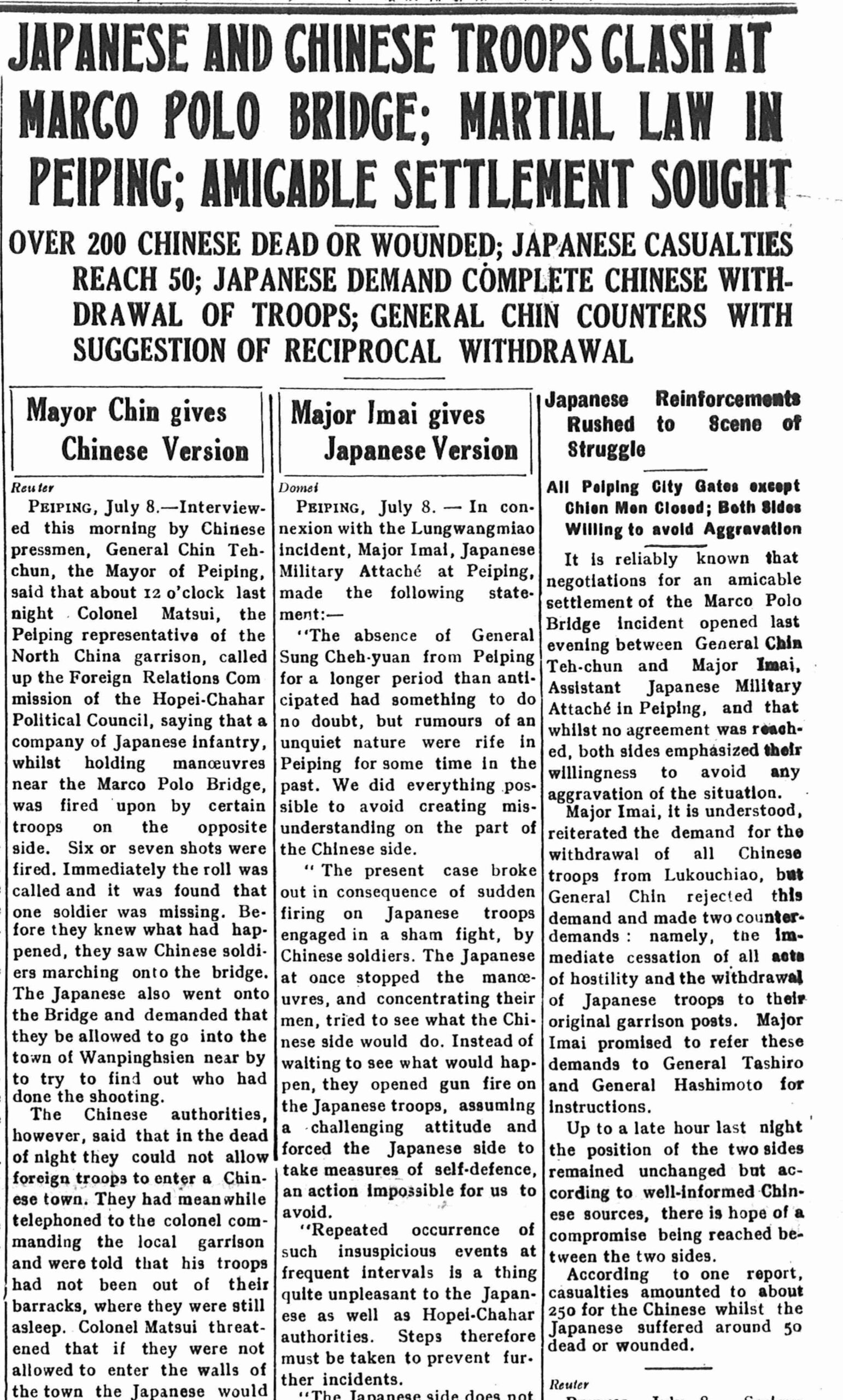
The Peiping Chronicle took a similar editorial stance giving column inches to both sides, despite being Chinese owned, initially suggesting that “there is hope of a compromise being reached.” Yet the apparent optimism proved fleeting. The Marco Polo Bridge Incident rapidly escalated into the Second Sino-Japanese War, a conflict many historians view as the beginning of the Second World War.
English-language newspapers from this period capture not only diplomatic rhetoric and military developments but also the uncertainty and fear felt by residents of North China as war engulfed the region.
A Vivid Record
The titles included in this collection offer a vivid record of 150 years of change in China whilst revealing the assumptions, ambitions, and anxieties of their editors, sponsors, and readers. At the same time, they document China’s evolving relationship with the outside world and provide valuable perspectives on events that reshaped the country. For researchers and students this newly digitised collection opens a rich and multifaceted window into China’s past.
If you enjoyed reading about the English-language press in China, check out these posts:
- Treaty Ports and Modern China
- Researching the History of Shanghai Between the 1830s and 1950s
- Uncovering the History of Twentieth-Century Hong Kong, China, and the World
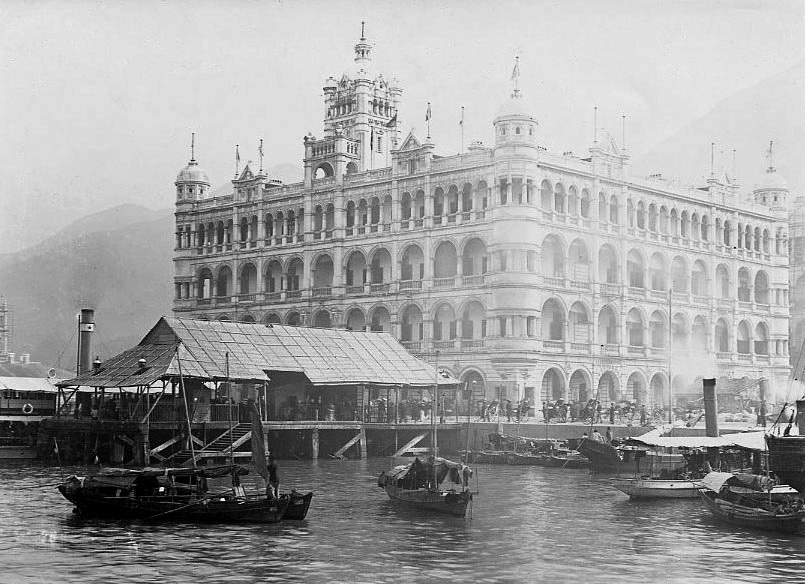
Blog post cover image citation: Hong Kong Waterfront, 1900s. Public Domain, via Wikimedia Commons https://commons.wikimedia.org/wiki/File:Queen%27s_Building_1890s_(Hong_Kong).jpg