
│By Sofía Sanabria de Felipe, Gale Ambassador at the University of Oxford│
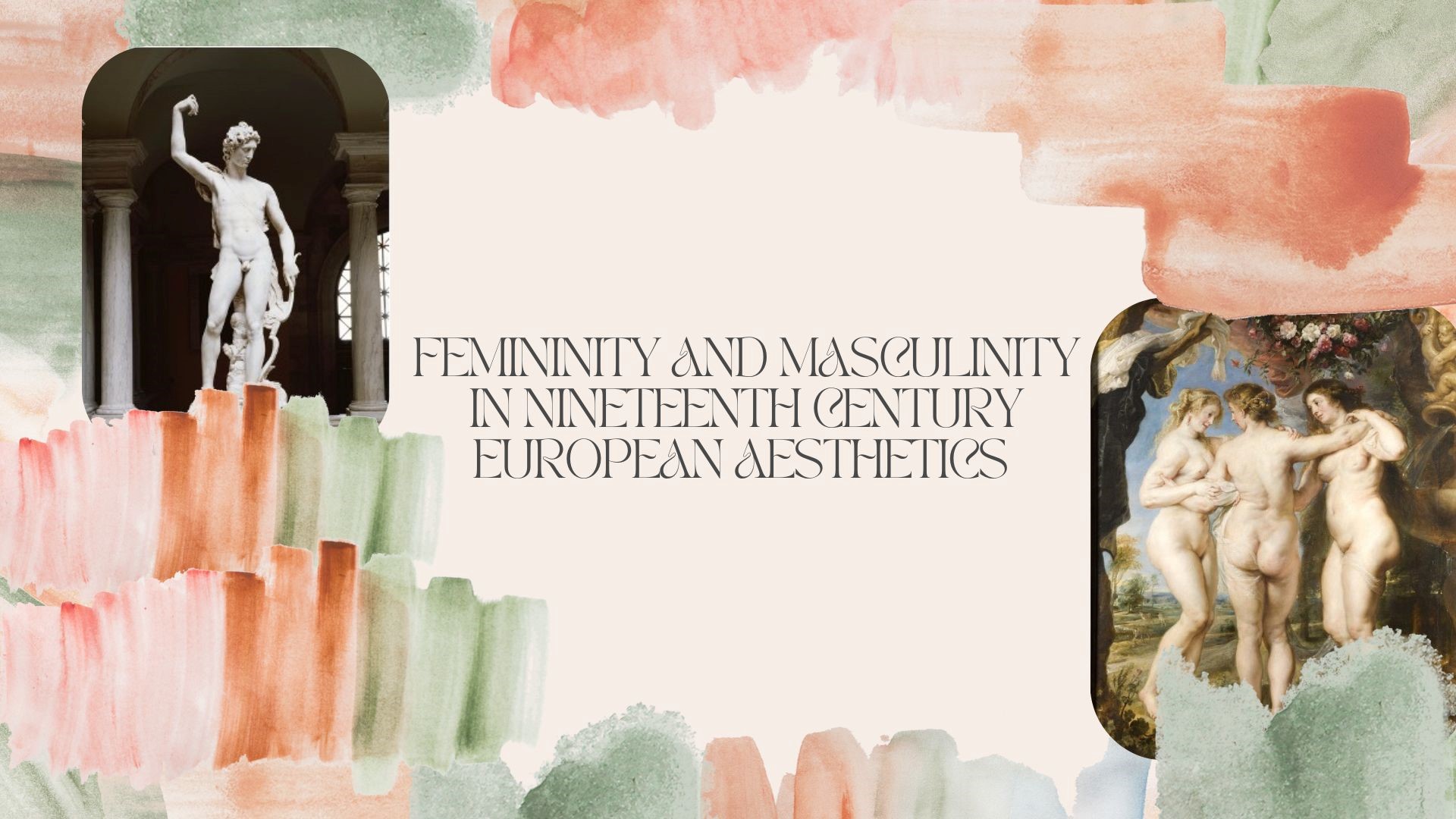
In March 2022, an exhibition entitled Fashioning Masculinities opened at the Victoria and Albert Museum in London. Its manifesto was to show a ‘history of changing ideas of masculinity’. The exhibition greeted visitors with a gallery of plaster-casts of statues in a Greco-Roman idiom. Amongst them stood Pietro Francavilla’s statue of Apollo, a Renaissance sculpture depicting the apparent timelessness of the nude masculine ideal of Western classical epistemology.

In his adaptation of Immanuel Kant’s Beobachtungen über das Gefühl des Schönen und Erhabenen (1764), Auguste-Hilarion comte de Kératry, an early-nineteenth-century French art critic and politician, employed the same famous statue in a passage concerning the physical attributes associated with the ideal man, and how no contemporary figure matched up to that masculine aesthetic ideal.1
Writing in the ideological aftermath of the French Revolution and Napoleonic military projects, the purpose of Kératry’s adaptation of Kant’s early work was to make Kant’s aesthetic epistemology speak to contemporary French readers by relating the content of his theories to contemporary lived experience.
Kératry primarily did this by making references to well-known aesthetic works, interlacing commentary/translation of Kant’s ideas with descriptions of pieces such as the Apollo sculpture. As the positioning of the Apollo in the V&A exhibition attests, representations of masculinity and femininity in art have been tenacious, as well as having tended to distort and flatten out resonances and particular histories of classical idealism.
The Aftermath of the French Revolution and Napoleonic Empires
As a historian working on the reception of Kant’s early works, who focuses on differences in aesthetic taste being subject to environmental, physiological, and cultural factors, it became undeniable to me how prevalent questions over masculinity and femininity became in the aftermath of events such as the French Revolution and Napoleonic Empires.
These two historical events had a profound demographic impact on France (loss of men and lower fertility rates). Furthermore, with the restoration of the monarchy following the Napoleonic Wars, there were ongoing debates over what the ideal forms of government were that would enable a strong future France to develop.
In direct response to this, intellectual figures of the time, such as Kératry, found that the education of young men – and a particular education at that – was of the utmost importance to ensuring a prosperous, non-divisive French state.
As a result, the cultivation of certain attributes and behaviours – framed within the language of classical masculinity – became useful tools in persuasively encouraging young men to follow a particular path. Kératry’s translation of Kant’s work was a step in that direction; a text to be treated as a ‘textbook’ of sorts for the younger generations.
The socio-demographic and educational impact of the French Revolution and Napoleonic Wars was not only felt in France but rather had a widespread effect across the Western world.
Interrogating the Archive
Luckily for me, Gale Primary Sources provides access to numerous collections explicitly dedicated to this century. With collections as substantial and varied as the archives presented by Gale, the in-built Topic Finder becomes an excellent tool to streamline and narrow your search for the sources that may seem most fruitful in responding to a particular research question.
Typing the term ‘gender’ into the Topic Finder function of Nineteenth Century Collections Online immediately seems to associate the term with ‘woman’.

Highlighted in red, showing the greatest volume of results, most sources associated with ‘gender’ seem to be concerned with women’s suffrage, key questions on women’s roles in public affairs (e.g. Can women hold office in Iowa?) and marriage, as is the case of the fascinating source We Often Hear Women Who Have Passed the Age When Most of Their Sex Have Married, Sneered at, Especially by the Masculine Gender, as If the Chief Aim of Woman Should Be to Sink Her Identity as a Woman by Marrying an Inferior Man, an article in the Woman’s Voice and Public School Champion (1891).

In both cases, I would argue that the term ‘gender’ itself is used to qualify men and their responses to woman and what is expected of her. This pattern is present, too, in the other collections, though more complex understandings of gender seem to be reflected in the topic distribution of each collection.
In both periodical collections, the words ‘lady’, ‘girl’, and ‘young woman’, break up the all-encompassing ‘woman’ category – as do the qualifying concepts of ‘feminine’ and ‘masculine’ genders.

What Does This Tell Us?
The interplay between femininity and masculinity represented here, as well as its links to the political circumstance of a time, are embodied by the Topic Finder’s reference to ‘feminine’ and ‘masculine’ categories. The sources placed within these algorithmic groupings, in turn, speak on the rather arbitrary – and crucially contingent – way in which beings, objects, and people are identified as belonging to either category.
This is particularly the case in the language used by a Cleveland Daily Herald reporter in 1848 discussing a young woman’s choice of accessory (parasol) to hide from the sun’s rays. Personifying the Sun in the masculine, the reporter presents this aesthetic trend in heavily gendered, heterosexual terms, reflecting the well-established representation of nineteenth-century desired femininity as ‘puritanical’.

Within the French context, as evidenced by my own research into the reception of Kant’s aesthetics, discussion of gender is definitively housed within an overarching understanding of how understandings of masculinity and femininity necessarily depend on and relate back to each other.
This is evident in a passage where Kératry, adapting Kant to his audience, speaks of the aesthetic appeal of Rubens’ ‘Three Graces’, as opposed to the ideal often associated with the Venus de Medici, as it speaks more directly to the contingent experience and heterosexual desires of the labouring men of France, rather than the abstracted ideal of Greco-Roman origin.2

Here, the corpulence of Rubens’ women is directly equated with the desired build of a woman capable of raising children and engaging in arduous farming labour, thus depicting the experience of rural households in France in the post-Napoleonic period. In both cases, understandings of abstract gender ideals are broken down, often by visual signs, and refined to reflect the cultural and political needs of a particular audience and time.
Where We Are Now
As historians, this exercise encourages us to think critically about the languages and ideas intellectual figures have historically turned to when making sense of complex socio-political moments and pushing for a brighter future. It is important to place these frameworks within their own specific contexts and ultimately understand differences in perspectives shared within these conversations.
After all, nothing can be more exciting than basking in the intellectual freedom that comes from embracing constant fluidity and change over time as core elements of our historical development.
If you enjoyed reading about nineteenth-century aesthetics and culture, check out these posts:
- Fabricating History: Empire Lines, Modern Designs, and the Politics of Dress in Regency Representations
- Perfecting the Elevator Pitch: Using Gale Primary Sources to Unpack Intellectual History
- Who was the Chevalier de Saint-Georges?
Blog cover image citation: A collage using the images in this blog and elements from Canva, created by the author.
- A-H, Kératry, Examen philosophique des “Considérations sur le sentiment du sublime et du beau, dans le rapport des caractères, des tempéraments, des sexes, des climats et des religions”, d’Emmanuel Kant, (Paris, 1823), p.115.
- A-H, Kératry, Examen philosophique des “Considérations sur le sentiment du sublime et du beau, dans le rapport des caractères, des tempéraments, des sexes, des climats et desreligions”, d’Emmanuel Kant, (Paris, 1823),p.6-7.