

│By Brendon Ndoro, Gale Ambassador at the University of Cape Town│
When does one acknowledge the impact of their decisions on society? How does one remedy their wrongdoings? When does one act in response to the threat their actions bring upon the welfare and sustainability of society and the environment?
These are a few questions Business Studies students may come across when delving into the world of business ethics. A great starting point to answering questions like these lies in understanding Corporate Social Responsibility (CSR). CSR is an ongoing practice in the world of business. It is a management concept focusing on the integration of social and environmental concerns into a business’s operations and relationships with various stakeholders.

Companies are increasingly being recognised as moral agents. This recognition is resulting in a large shift in corporate efforts to address the impact their actions have on the environment and broader society. Analysing CSR helps to discover new strategies to keep businesses accountable.
CSR practices have also led to the development of initiatives such as mitigating carbon footprints, establishing fair trade practices, and supporting local communities and their development. The Times Digital Archive is a valuable resource for those who are interested in understanding corporate ethics and its evolution over time. Understanding CSR is not just limited to current affairs, but it is also linked to historical developments.
CSR Through History
CSR is a long-developed concept, with articles within the Times Digital Archive reaching as far back as the nineteenth century. Through exploration, students can discover its roots in the archive. In the Victorian era, philanthropy entailed funding education and health care to improve the welfare of workers. During the post-war period, CSR is reflected in the increasing concerns of accountability within the corporate space. In particular, concerns around fair labour practices were raised.
Now, in the modern world, CSR’s evolution into a global priority is illustrated through various sustainability initiatives. Currently, there are seventeen Sustainable Development Goals (SDGs) created by the United Nations (UN). These were all adopted during the UN General Assembly by the 193 Member States on September 25, 2015. As a part of the 2030 Agenda for Sustainable Development, these goals aim to address challenges faced globally and improve the quality of life for people all over the world.
Research Strategies for Students
The Times Digital Archive is available to use for conducting research or adventuring into some insightful reading. One can navigate the archive by entering targeted keywords in the advanced search bar. Using words and terms such as “corporate social responsibility”, ethics, business, sustainability, and philanthropy should be enough to start off research on CSR. Applying filters for the date assists in analysing trends across specific periods, such as the Renaissance or the post-Apartheid transition.
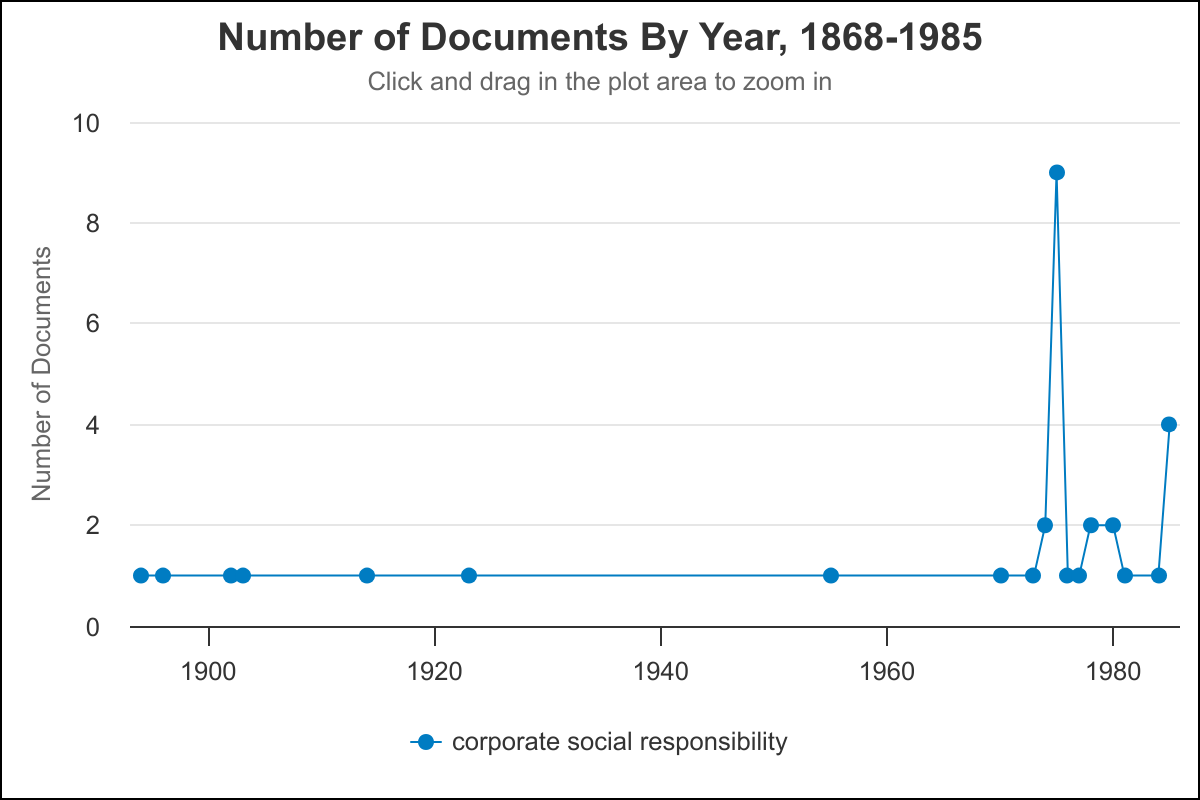
Utilising the Term Frequency tool, you can analyse how often CSR is discussed in different resources over time. This is a great tool for determining its relevance in the corporate world. Different perspectives tend to reflect conflicting societal attitudes. Utilising primary resources such as the Times Digital Archive is great for visualising how corporations presented themselves. Reviewing contrasting perspectives will strengthen your understanding of CSR. After all, it is a concept shaped by various social forces, such as economic, political, and cultural influences.
What Makes CSR So Valuable for Business Studies?
CSR is the key to understanding ethical decision-making on a deeper level. Enhancing the brand’s reputation, employee satisfaction, and attracting further investment into the business are key areas of focus in developing a company. Engaging in CSR is vital to addressing these key areas is vital in keeping the company ahead and to do so ethically.
Companies utilise CSR to improve their public image. By building the consumers’ trust, a business can increase customer loyalty and revenue. Prioritising ethical practices and pursuing sustainable development goals is a critical factor in attracting investment into the company. Workers have a preference for labour at socially responsible companies. Companies with CSR initiatives have higher levels of morale and retention amongst employees.
Operating in accordance with regulations helps companies avoid legal issues. Using historical knowledge of CSR can inform business studies students about strategies used to ensure responsible leadership in a globalised economy.
The Times Digital Archive goes further than collecting newspapers and articles. It enlightens research on the developing relationship existing between business and society. Students can discover the origins of CSR, analyse how it changed through different perspectives over time, and apply lessons hidden within the archive to address contemporary challenges.
If you enjoyed reading about Corporate Social Responsibility, check out these posts:
• Chatham House Online Archive and International Law
• Business, Bribery and the Broadsheets: Researching Companies and Industry with The Daily Telegraph
• New Environmental History Archive: Colonial Policy and Global Development, 1896-1993
Blog cover image citation: Hornsby, Michael, and Christopher Follett,. “Army helps run strike-hit Soweto hospital after sacking of 800 nurses.” Times, November 18, 1985, 7. The Times Digital Archive. https://link.gale.com/apps/doc/CS117674354/TTDA?u=webdemo&sid=bookmark-TTDA&pg=7&xid=852f6bef.